OREO Strategy: The Secret to Excelling in IELTS Speaking Part 3
Here is your complete English translation, preserving structure, clarity, and a professional academic tone:
Master the OREO Strategy for IELTS Speaking Part 3: A Complete Guide with Practical Examples and Step-by-Step Training from Fehmistein to Achieve Band 7+
Introduction: Why Is Part 3 the Most Challenging?
The IELTS Speaking test is one of the most challenging sections for many students—especially Part 3, which requires extended, in-depth answers on abstract topics rather than simple personal questions. Do you feel nervous or hesitant when answering these questions? The solution lies in a smart and simple technique known as the OREO strategy.
In this article from Fehmistein, we explain this powerful strategy step by step and show you how to make your answers more coherent and persuasive to achieve your target band score.
What Is the OREO Strategy?
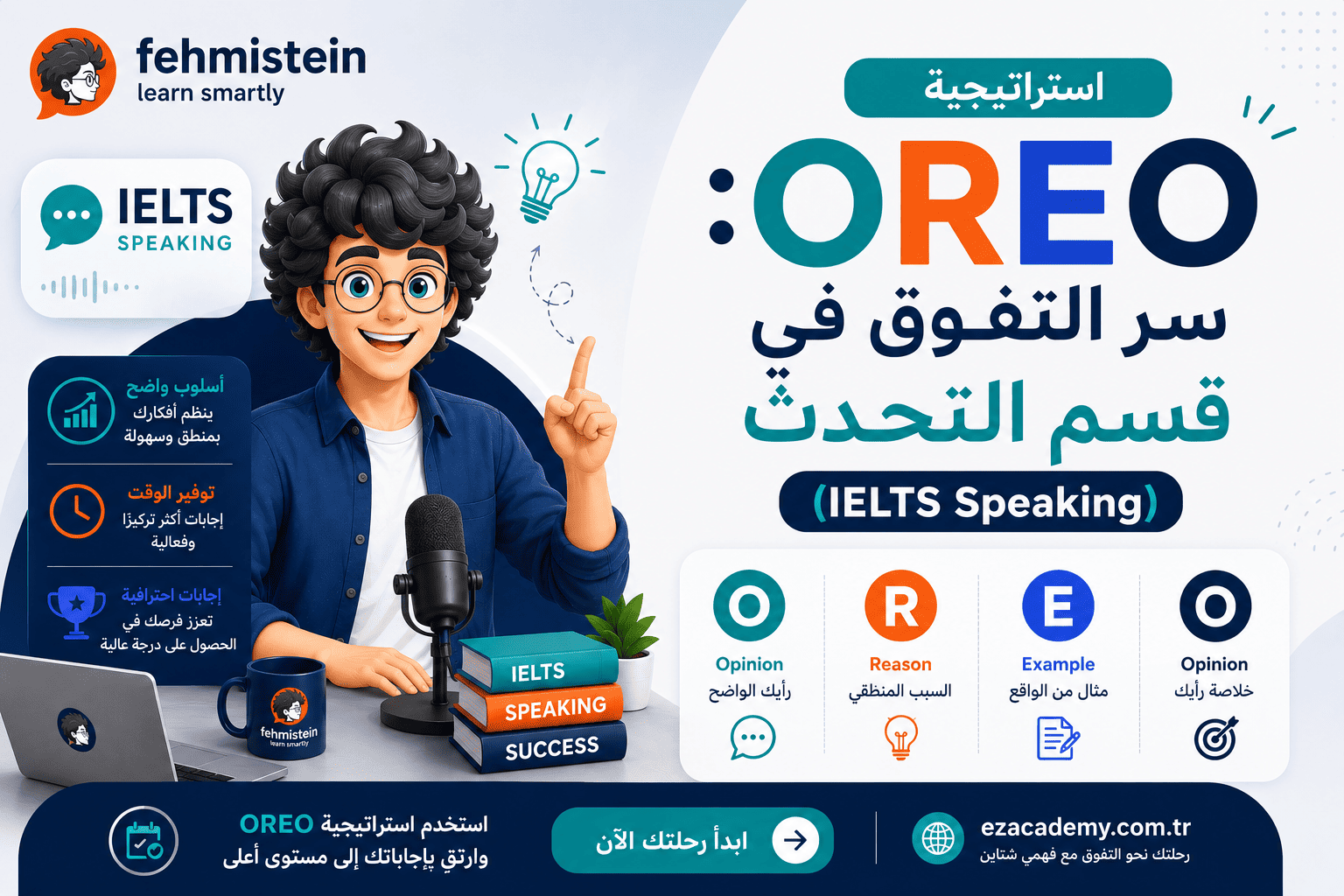
The OREO strategy is a structured method that helps you organize your ideas in seconds. It stands for four key components:
- O (Opinion): Clearly state your opinion from the very first sentence.
- R (Reason): Explain why you hold this opinion using linking words such as because, due to, or since.
- E (Example/Evidence): Support your idea with a real-life example or concrete evidence.
- O (Opinion/Closing): Restate or reinforce your opinion with a strong concluding thought.
Why Do Examiners Prefer OREO?
- Eliminates hesitation: Provides a mental roadmap, reducing pauses and improving fluency.
- Improves coherence: Helps you structure your ideas logically—one of the key scoring criteria.
- Showcases real language ability: Encourages the natural use of connectors and academic vocabulary.
Practical Example of OREO
Examiner Question: “Do you think technology has reduced the importance of reading in schools?”
- Opinion: “Yes, I believe that reliance on digital tools has negatively affected traditional reading habits among students.”
- Reason: “This is mainly because technology provides quick access to information, making students prefer fast visual content over reading long texts.”
- Example: “For instance, in my school, many students tend to watch video summaries instead of reading full chapters of literature books.”
- Closing Opinion: “Therefore, I believe we need a balance between technology and traditional methods to maintain critical thinking skills.”
Additional Example: Workplace Topic
Examiner Question: “Do you think working from home is better than working in an office?”
- Opinion: “In my opinion, working from home has become a better option for many employees nowadays.”
- Reason: “This is because it offers greater flexibility and reduces exhausting commuting time.”
- Example: “For example, one of my relatives improved their performance significantly after switching to remote work, as they used commuting time to rest and focus.”
- Closing Opinion: “However, I believe a hybrid model is ideal to maintain human interaction in the workplace.”
Notice how the same structure applies regardless of the topic—this is the true strength of the OREO strategy.
Common Mistakes to Avoid
- Memorizing full answers: Examiners can easily detect memorized responses, which lowers fluency scores. Focus on the structure, not fixed sentences.
- Skipping the reason: Jumping from opinion directly to example weakens logical flow.
- Overextending the example: One clear example is better than a long, unfocused story.
- Repeating the same wording: Paraphrase your opinion in the conclusion to demonstrate lexical range.
Useful Linking Phrases
Using varied connectors improves your Coherence and Cohesion score:
- Opinion: In my opinion / Personally, I believe / From my perspective
- Reason: This is mainly because / The main reason is / Due to the fact that
- Example: For instance / To illustrate / A clear example is
- Conclusion: Overall / Taking everything into account / That’s why I believe
Practicing variation in these expressions enhances your fluency and vocabulary score.
Frequently Asked Questions
- Is OREO suitable for all speaking parts?
- It is mainly used for Part 3, but elements like reason and example can support Part 2 responses as well.
- How long should an OREO answer be?
- Ideally between 30–45 seconds—long enough to develop ideas without overextending.
- Can it become automatic?
- Yes. With practice, it becomes a natural mental habit during the test.
How Fehmistein Helps You Master OREO
At Fehmistein, we focus on practical mastery, not just theory:
- Interactive practice: Real speaking exercises with expert guidance.
- Performance analysis: Detailed feedback to eliminate repetition and unnecessary length.
- Fluency development: Training on advanced connectors and natural speech flow.
- Flexible learning plans: Available through the Packages Page, giving you full access to all preparation tools.
You can also explore a detailed guide on all four IELTS sections, browse IELTS articles, or read about thinking in English instead of translating to further boost your speaking performance.
Start Your Journey to Speaking Mastery
The OREO strategy is just the beginning. With the right training and guidance from Fehmistein, you can transform from a nervous test-taker into a confident speaker achieving Band 7 or higher.
Are You Ready to Improve with Confidence?
Join the IELTS track on Fehmistein today, benefit from a free trial, and practice the OREO strategy step by step.
Similar Articles