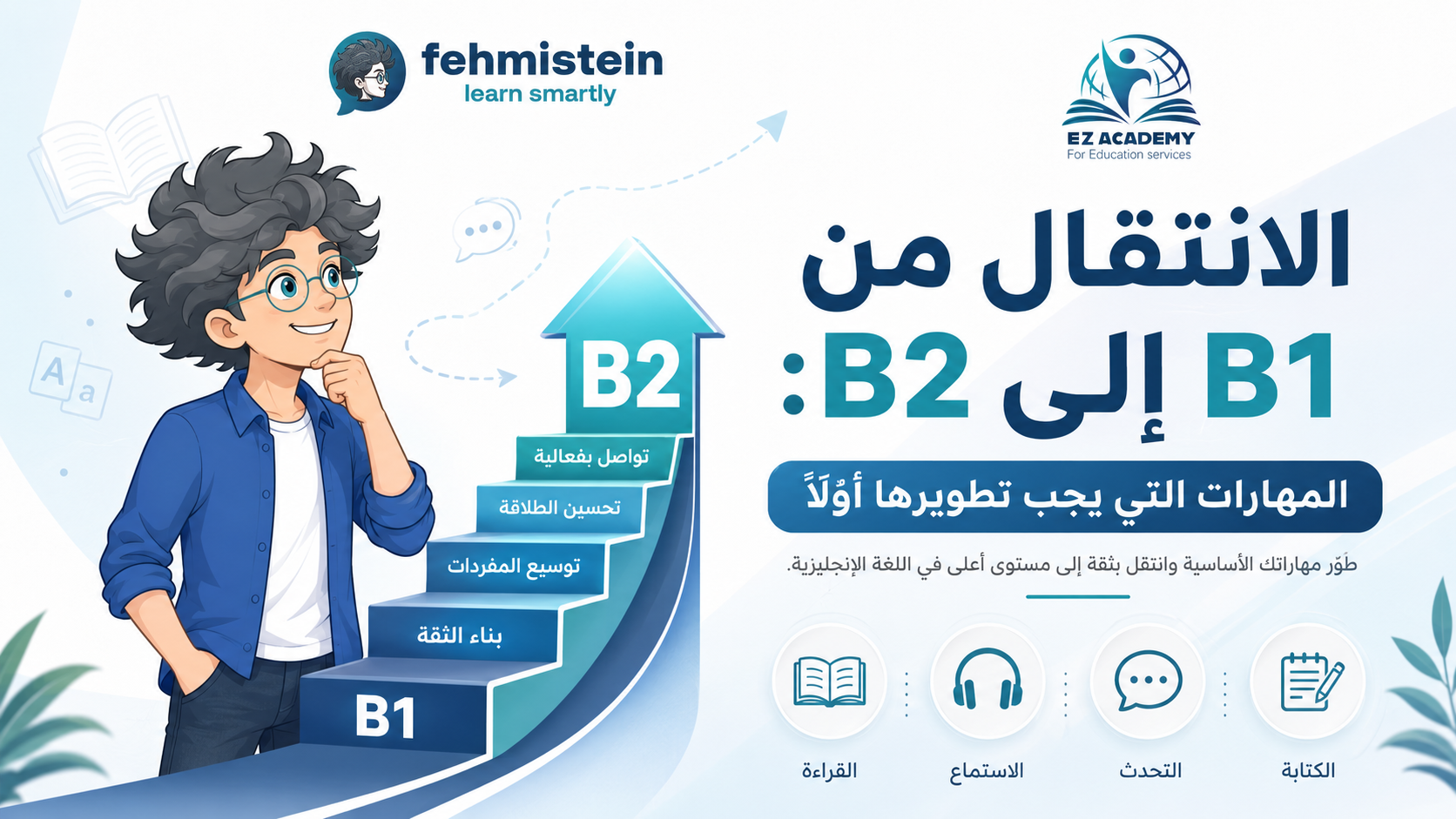
How to Move from B1 to B2 in English: The Skills You Need to Develop
The Key Skills You Need to Develop to Move from B1 to B2 in English
Discover a practical plan to improve your reading, listening, writing, and speaking skills and prepare for IELTS and TOEFL with Fehmistein by EZ Academy.
Introduction: Why Do Many Learners Get Stuck at B1?
Many English learners reach the B1 level and then feel that their progress has slowed down. At this level, students can understand everyday conversations, read intermediate texts, and express their main ideas. However, they may struggle when discussing more complex topics, writing organized texts, following academic content, or speaking fluently without constantly translating.
Moving to B2 is not simply about memorizing more words. It requires the ability to use English with greater flexibility and accuracy in a wider range of situations. In this article from Fehmistein and EZ Academy, we explain which skills you should develop first and how to build a realistic plan to reach your goal.
The transition from B1 to B2 generally requires balanced development across vocabulary, grammar, reading, listening, writing, and speaking—not passive exposure alone.learnenglish.britishcouncil
What Is the Difference Between B1 and B2?
B1 is considered an intermediate level, while B2 is classified as upper-intermediate. Here is the practical difference between the two levels.
At B1, a student can usually:
- Understand the main ideas of familiar topics.
- Manage everyday situations.
- Talk about experiences and plans.
- Write simple, connected texts.
- Express an opinion in a basic way.
At B2, a student is expected to:
- Understand and analyze more complex texts.
- Follow general and academic discussions.
- Speak with greater fluency while providing reasons and examples.
- Write clear, organized, and coherent texts.
- Use English for study and work.
- Interact without relying constantly on translation.
The main difference is not simply the amount of information you know. It is your ability to use what you know more quickly, flexibly, and accurately.
Common Reasons Learners Do Not Progress from B1 to B2
- Focusing on grammar without using it in real communication.
- Memorizing individual words without context.
- Listening only to content that is easier than the required level.
- Not practicing writing and speaking regularly.
- Avoiding long texts or unfamiliar topics.
- Relying constantly on translation.
- Studying without analyzing weaknesses.
- Having no clear goal or consistent plan.
Ten Skills You Need to Develop
1. Expand Your Active Vocabulary
A B1 student may know many words but use only a limited selection while writing and speaking. Words that you understand but cannot use are called passive vocabulary, while words you can recall quickly are part of your active vocabulary.
To move toward B2:
- Learn words in context rather than as separate lists.
- Use synonyms and related words, such as effective or beneficial instead of using good in every situation.
- Learn common expressions as complete language units.
- Use each new word in at least three different sentences.
2. Develop Deeper Reading Comprehension
At B1, you may understand the general idea of a text. At B2, you need deeper comprehension, including:
- The writer’s attitude and purpose.
- The relationship between ideas and paragraphs.
- Implied meanings and conclusions drawn from context.
- The difference between the main idea and supporting details.
Practical exercise: After reading any text, ask yourself:
- What is the main idea?
- What is the writer’s position?
- How can I summarize the text in three sentences?
Begin with intermediate texts and gradually move to educational articles and introductory academic materials.
3. Improve Your Understanding of Natural English
A B1 student may understand clear educational recordings but struggle with natural speech because of speed and connected pronunciation.
To reach B2, you need to:
- Follow the main idea without understanding every word.
- Distinguish important information from secondary details.
- Take brief notes while listening.
Suggested method: Listen to a recording twice. Listen once for the general idea and a second time to note important words. Then summarize the content in your own words aloud.
4. Move from Sentences to Organized Paragraphs
A B1 student may be able to write grammatically correct sentences but struggle to build a coherent paragraph. At B2, organize your writing using this structure:
Main idea → Explanation → Example → Result
Pay attention to:
- Using linking words.
- Varying sentence structures.
- Avoiding repetition.
- Reviewing mistakes before submitting your work.
5. Develop Speaking from Short Answers to Extended Ideas
At B2, you are expected to explain your opinion, provide reasons, give examples, make comparisons, and discuss relatively unfamiliar topics.
Use this structure:
Opinion + Reason + Example + Result
Useful expressions include:
- In my opinion…
- One of the main reasons is…
- For example…
- On the other hand…
- As a result…
- It depends on…
6. Use Grammar Accurately in Real Situations
At B2, you do not need to memorize every grammar rule, but you should use basic and intermediate structures more accurately.
Important areas include:
- Basic and advanced tenses.
- The present perfect and past perfect.
- Conditional sentences.
- The passive voice.
- Relative clauses.
- Linking words and complex sentences.
A common problem is knowing a rule in an exercise but failing to use it while speaking or writing.
Solution: After studying a grammar rule, immediately use it in sentences connected to your own life.
7. Improve Pronunciation and Rhythm
B2 does not require a perfect accent, but your speech should be clear and easy to understand.
Focus on:
- Correct word stress.
- Pronouncing word endings clearly.
- Distinguishing between similar sounds.
- The rhythm of the entire sentence, not just individual words.
8. Reduce Your Dependence on Translation
Start thinking in simple, direct English. When you forget a word, do not stop. Explain its meaning instead:
“It is something we use to…”
The ability to paraphrase is an important sign of real progress toward B2.
9. Learn to Summarize Information
Summarizing is an essential B2 skill. It requires you to understand an idea and reproduce it in your own words.
After reading a text:
- Identify the main idea.
- Choose the three most important points.
- Ignore secondary details.
- Use your own words rather than copying the writer’s language.
This skill is useful for university study and for IELTS and TOEFL alike.
10. Build Independent Learning Skills
At B2, you should be able to identify:
- Which skill is weakest.
- What types of mistakes you repeat.
- Whether your performance is actually improving.
Do not measure progress only by the number of lessons you complete. Use real performance results to track your development.
Which Skill Should You Start With?
There is no single order that works for every student. Begin with the skill that is preventing you from developing the others.
- Start with vocabulary and grammar if you cannot build clear sentences or frequently stop because of missing words.
- Start with listening and speaking if you understand written English but cannot use what you know orally.
- Start with reading and writing if your goal is academic study or IELTS and TOEFL preparation.
To identify your actual level before setting priorities, you can take a free placement test from Fehmistein. If you are preparing to move from B2 into international exam preparation, read our article “Is B1 or B2 Enough to Start Preparing for IELTS and TOEFL?” to learn about readiness indicators and the next steps.
A Practical B1-to-B2 Plan
Stage One: Diagnose Your Level
Complete an assessment covering:
- Reading.
- Listening.
- Grammar.
- Vocabulary.
- Writing.
- Speaking.
Do not rely only on a multiple-choice test, because productive skills are often weaker than receptive skills.
Stage Two: Strengthen Your Foundation
Focus on:
- High-impact grammar.
- Common vocabulary.
- Sentence construction.
- Understanding intermediate texts.
- Daily listening.
- Speaking about familiar topics.
Stage Three: Develop Upper-Intermediate English
Move gradually toward:
- Longer texts.
- More complex topics.
- Organized writing.
- Summarizing.
- Academic vocabulary.
- Timed practice.
Stage Four: Evaluate and Apply
Complete regular tests, short writing tasks, and audio recordings. Compare your performance every few weeks.
Real progress occurs when your skills become stable—not simply when you complete a certain amount of time.
Suggested Weekly Routine
Every day:
- 20 minutes of reading or listening.
- 10 minutes reviewing vocabulary.
- 10 minutes of speaking or writing.
- Review one recurring mistake.
Three times a week:
- Read and analyze a text.
- Summarize an audio recording.
- Write an organized paragraph.
- Record and review a spoken response.
Once a week:
- Complete a short test.
- Review the results and choose the following week’s focus skill.
- Repeat an activity in which you previously made mistakes.
Consistency is more important than irregular intensive study.
How Do You Know You Are Close to B2?
You will begin to see real progress when you can:
- Understand longer texts without constant translation.
- Discuss different topics and develop your answers with reasons and examples.
- Write clear and connected paragraphs.
- Use a wider range of vocabulary.
- Paraphrase an idea when you forget a word.
- Make fewer basic mistakes.
- Understand and respond more quickly.
How Is B2 Related to IELTS and TOEFL?
Reaching B2 is an important step for students who want to begin serious preparation for international exams. However, B2 does not automatically guarantee a specific score. These exams also require:
- Knowledge of the test structure and question types.
- Time management.
- Organized writing and speaking.
- Practice with academic tasks.
- Full mock tests and error analysis.
Therefore, B2 is a suitable starting point in many cases, but it should be followed by specialized test preparation. You can explore the exam preparation tracks on Fehmistein, which include specialized IELTS, TOEFL, and SAT programs.
We also recommend reading our article, “How to Build a SAT, TOEFL, or IELTS Preparation Plan Based on Your University Requirements”, to learn how to turn admission requirements into a clear training plan.
How EZ Academy and Fehmistein Support You
EZ Academy is an educational services company specializing in international university admissions, with more than nine years of experience. It helps you:
- Define your English-learning goal.
- Choose the right language course for your level.
- Decide whether you need foundation training or direct preparation for an international exam.
- Apply for international university admissions.
Fehmistein is the smart training platform established by EZ Academy. It offers specialized IELTS, TOEFL, and SAT tracks, including practice activities, mock tests, error review, and performance analysis.
You can choose from our affordable packages, or contact the EZ Academy team for a free educational consultation via WhatsApp: +90 552 574 12 76.
Frequently Asked Questions
How long does it take to move from B1 to B2?
There is no fixed timeframe. It depends on your starting level, the number of study hours, the quality of your practice, and your consistency.
Can I reach B2 through self-study?
Yes, but you need a clear plan, suitable resources, and regular assessment—especially for writing and speaking.
Is B2 enough to start IELTS or TOEFL preparation?
It may be suitable for many students, but the decision depends on your target score, the balance between your skills, and the results of your diagnostic assessment.
How can I improve my speaking from B1 to B2?
Speak every day, record your responses, use reasons and examples, learn functional phrases, and review your mistakes after speaking.
Does watching movies help me reach B2?
Movies can help with listening and vocabulary, but they are not enough without regular reading, writing, speaking, and review.
Build Your Skills Before Moving to Your Next Goal
Moving from B1 to B2 is not achieved by memorizing more grammar rules and vocabulary alone. It requires developing your ability to use English in reading, listening, writing, and speaking.
Start by assessing each skill separately and setting your priorities. Activate your vocabulary, read deeply, listen to natural content, write organized paragraphs, speak aloud, and review your mistakes consistently.
👉 Start by checking your level for free with Fehmistein
Prepared by: The Educational Content Team — EZ Academy and Fehmistein
Similar Articles