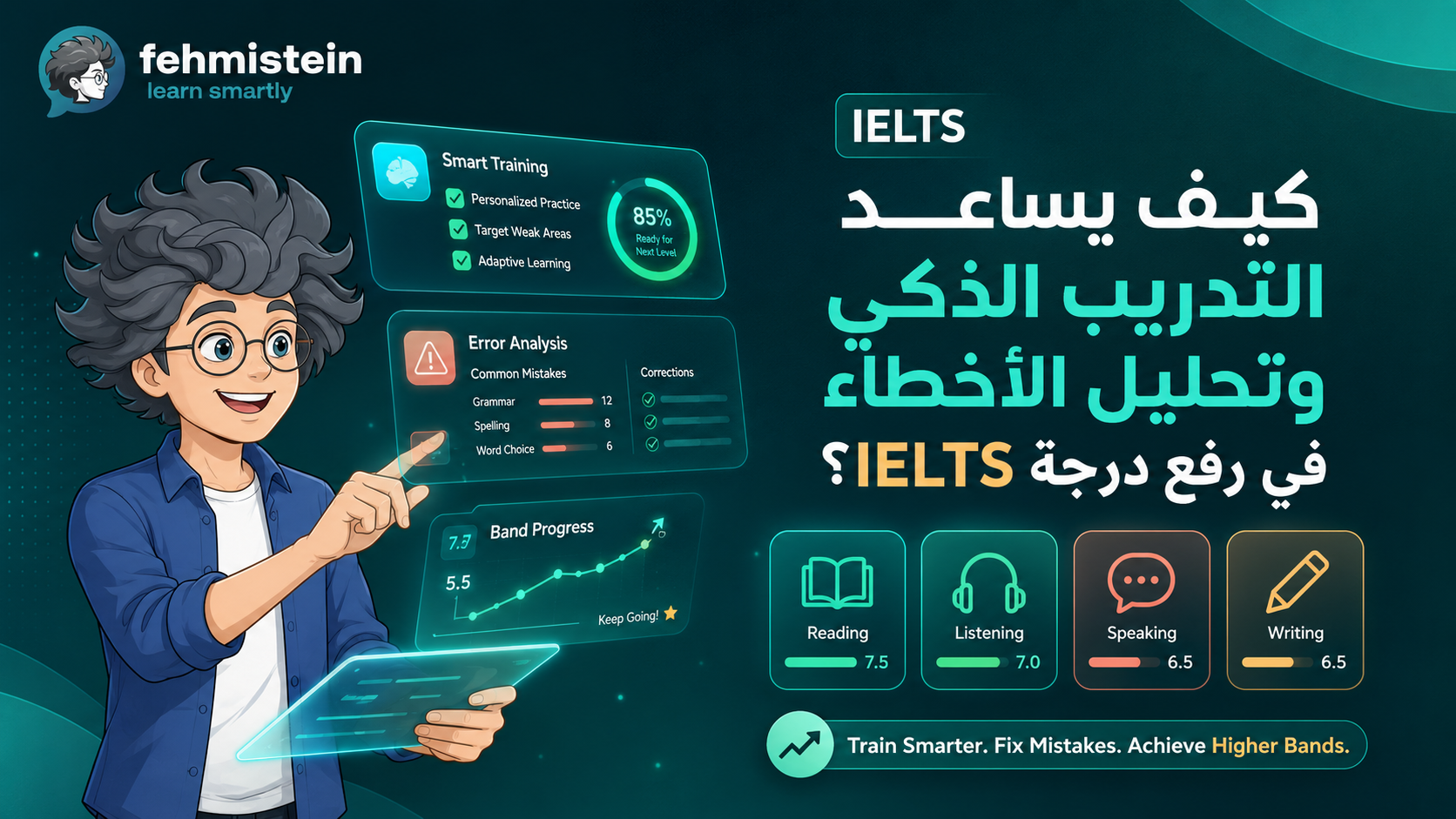
How to Improve Your IELTS Score Through Smart Practice and Error Analysis
Solving Dozens of IELTS Practice Tests Is Not Enough to Improve Your Score
Discover the smart training methodology and error-analysis techniques for all four IELTS skills, along with a practical preparation plan from Fehmistein by EZ Academy.
Introduction: Why Does Your Score Remain the Same?
Many students solve dozens of IELTS practice tests, yet their scores remain unchanged or improve very slowly. A student may complete full Reading tests, listen to many recordings, and write several essays—but still does not know:
- Why do the same mistakes keep recurring?
- Which skills should receive priority?
- Is the problem related to language ability or test strategy?
This is where the difference between doing more practice and practicing intelligently becomes clear.
Traditional preparation focuses on the number of hours studied and questions answered. Smart preparation focuses on a complete cycle:
Practice → Analyze the error → Identify its cause → Treat the skill → Measure again
In this article from Fehmistein and EZ Academy, we explain this methodology step by step and apply it to all four sections of the IELTS test.
Why Are Many Practice Tests Not Enough?
If you answer a question incorrectly and immediately move to a new practice test without understanding why, you will repeat the same mistake in a different form.
A student may complete five Reading tests and continue to make mistakes in True/False/Not Given or Matching Headings questions. The problem is not a lack of practice tests; it is the absence of analysis between one test and the next.
A mock test measures your performance, but it does not automatically improve it. Analyzing two tests thoroughly can be more beneficial than completing ten tests quickly. Reviewing mistakes after practice is also widely recommended as a way to identify the reason behind recurring errors.elmadrasah
Error Classification: The Most Important First Step
Not every wrong answer is caused by weak language ability. IELTS mistakes can be divided into five categories, and each category requires a different solution.
- Language error: Weak vocabulary, grammar mistakes, spelling problems, or difficulty paraphrasing.
- Question-understanding error: Missing an important word in the instructions or confusing False with Not Given.
- Strategic error: Reading the entire passage slowly before looking at the questions or using a writing structure that does not fit the prompt.
- Timing error: Spending too much time on one passage or failing to leave enough time to review your writing.
- Focus error: Writing a plural answer instead of a singular one or copying a number or name incorrectly.
Studying more vocabulary will not solve poor time management, and completing full tests will not fix a grammar rule you have not understood. Identifying the type of mistake is the real starting point.
Smart Training for the Four IELTS Skills
1. IELTS Listening
Common mistakes
- Losing focus after missing an answer.
- Spelling mistakes in heard words.
- Exceeding the permitted word limit.
- Failing to notice when a speaker corrects information.
- Confusing singular and plural forms.
What analysis reveals
- How many mistakes were specifically caused by spelling?
- Does accuracy decrease toward the end of the recording?
- Is the main problem with gap-completion questions or multiple-choice questions?
Treatment plan
- Practice one question type in each session.
- Predict the type of answer before playing the recording.
- Keep a list of words you frequently misspell.
- Review the written transcript after practice.
2. IELTS Reading
Common mistakes
- Reading too slowly and wasting time.
- Failing to recognize synonyms and paraphrases.
- Confusing False with Not Given.
- Using personal knowledge instead of returning to the passage.
- Spending an unbalanced amount of time on the three passages.
What analysis reveals
- Is the student good at Sentence Completion but losing most marks in Matching Headings?
- Does the student understand the passages but spend time inefficiently?
- Is the problem mainly with the first passage or the third?
Treatment plan
- Isolate the weakest question type and practice it separately.
- Begin with short sets without time pressure.
- Gradually move to timed practice.
- Integrate the question type into a complete passage once performance becomes stable.
For more information about time strategies, read Secrets of Time Management in Every IELTS Section.
3. IELTS Writing
Common mistakes
- Failing to answer every part of the question.
- Giving general ideas without development or supporting examples.
- Memorizing introductions that do not fit the prompt.
- Repeating the same vocabulary throughout the paragraphs.
- Distributing time poorly between Task 1 and Task 2.
Remember that Task 2 carries twice the weight of Task 1 in the Writing score. Therefore, wasting time on Task 1 can be particularly costly.
What should be analyzed in each essay?
- Was the question understood accurately?
- Is the writer’s position clear from the beginning?
- Does each paragraph contain a main idea and supporting evidence?
- Are the linking words natural or forced?
- Is the vocabulary precise or repetitive?
Treatment plan
- Analyzing one essay deeply is better than writing five essays without review.
- Create a Writing error log that includes the mistake, its cause, and the treatment method.
- Practice developing paragraphs using this structure:
Idea → Explanation → Example → Result
For additional strategies that complement Writing, read The OREO Strategy for IELTS Speaking Part 3.
4. IELTS Speaking
Common mistakes
- Giving answers that are too short and underdeveloped.
- Memorizing complete answers that sound unnatural.
- Pausing for too long while searching for the perfect word.
- Repeating the same expressions in all three parts.
- Focusing on accent rather than clarity of pronunciation and ideas.
What does recording and analyzing your answer reveal?
- The number of long pauses and their average duration.
- How clearly the main idea is expressed.
- The range of vocabulary used in one answer.
- Your ability to correct a mistake and continue naturally.
Treatment plan
- Record your answer and analyze only one or two problems.
- Rebuild the answer and record it again.
- Compare the two attempts.
The goal is not to memorize the improved answer. It is to learn how to develop any similar response.
When Should You Use Mock Tests?
You should not turn every study session into a full test. Use mock tests at three key stages:
- At the beginning: To identify your current score and weaknesses.
- During preparation: To measure the effect of targeted training.
- Before the official test: To simulate timing, pressure, and section order.
After each mock test:
- Review your answers instead of immediately moving to another test.
- Classify your mistakes as language, strategic, timing, or focus errors.
- Set the training priority for the following week.
- Complete focused practice before taking the next test.
You can access the mock tests on Fehmistein to begin measuring your current level.
An Eight-Week Smart Training Plan
Week 1 — Diagnosis
- Take a placement test.
- Complete a full IELTS diagnostic test.
- Identify your current and target scores.
- Create an error log.
Weeks 2–3 — Foundation Treatment
- Review language-related mistakes.
- Practice the weakest question type.
- Develop vocabulary, writing, or speaking skills.
Weeks 4–5 — Guided Practice
- Complete question sets organized by skill.
- Introduce timed practice gradually.
- Analyze mistakes after every session.
Week 6 — Integration
- Complete full sections.
- Apply test strategies.
- Compare your results with the initial assessment.
Week 7 — Simulation
- Complete a full mock test.
- Analyze the results and identify the remaining gaps.
Week 8 — Consolidation
- Complete light, focused practice.
- Review your error log.
- Prepare for test-day procedures.
How Do You Know Your Training Is Actually Improving Your Score?
Do not rely on the result of one test. Monitor these indicators together:
- Higher average accuracy in question types that were previously weak.
- Fewer recurring mistakes in your error log.
- Improved performance in your weakest skill.
- Less time spent while maintaining or improving accuracy.
- More stable results across several tests.
- Better writing quality and longer, more developed spoken responses.
Track each section separately, because one skill may improve before the increase appears in your overall score.
Common Mistakes That Prevent IELTS Score Improvement
- Completing tests one after another without review: Repetition alone does not treat the cause of mistakes.
- Studying all four skills equally: One skill may require much more time than the others.
- Memorizing Writing and Speaking answers: This leads to unsuitable answers when the question changes.
- Ignoring instructions: Exceeding the word limit can cost marks even when the answer is otherwise correct.
- Reviewing only the correct answer: You also need to understand why the wrong answer seemed convincing.
- Not practicing under timed conditions: Your performance outside test conditions may be very different under pressure.
For a complete overview of the IELTS preparation journey, read IELTS Roadmap 2026: A Practical Guide from Zero to Band 7+.
If you are deciding whether you need a language course or direct test preparation, read Do You Need a Language Course or Test Preparation?.
The Role of Fehmistein and EZ Academy
Fehmistein is the smart training platform established by EZ Academy. It helps students move from random practice to an organized preparation path that includes:
- A clear IELTS training track.
- Practice activities categorized by skill and question type.
- Mock tests to measure progress.
- Error review and performance analysis.
- Accurate identification of strengths and weaknesses.
- Progress tracking over time.
EZ Academy is an educational services company with more than nine years of experience. It offers free educational consultations to help you identify the right test for your university pathway, determine the score required by your university, and apply for international admissions.
For consultation, contact the team via WhatsApp: +90 552 574 12 76.
Choose from the affordable Fehmistein packages according to your time and budget, and begin with a free placement test to identify your actual starting point.
Frequently Asked Questions
How can I improve my IELTS score?
Start with a diagnostic test, identify your weakest skill, classify your mistakes, and then complete focused practice and regular tests to measure improvement.
Are mock tests alone enough?
No. You must review every test and analyze the causes of your mistakes before moving to a new practice test.
How can I identify the reason my score is not improving?
Compare your performance by question type and time spent. Then determine whether your mistakes are related to language, strategy, or timing.
How many questions should I solve each day?
There is no fixed number. A small set followed by detailed analysis is better than a large number of questions without review.
Can artificial intelligence evaluate Writing and Speaking?
Artificial intelligence can organize mistakes and provide feedback. However, accurate assessment according to IELTS criteria also benefits from human academic review.
Turn Every Mistake into a Step Toward Your Target Score
Improving your IELTS score does not depend on intensive study alone. It depends on the quality of your training and your ability to understand your mistakes and turn them into a practical plan.
Do not ask only, “How many questions did I solve?” Also ask:
- What mistakes kept recurring?
- Why did they happen?
- What training should I complete next?
👉 Start your free trial on Fehmistein today
Prepared by: The Educational Content Team — EZ Academy and Fehmistein
Similar Articles