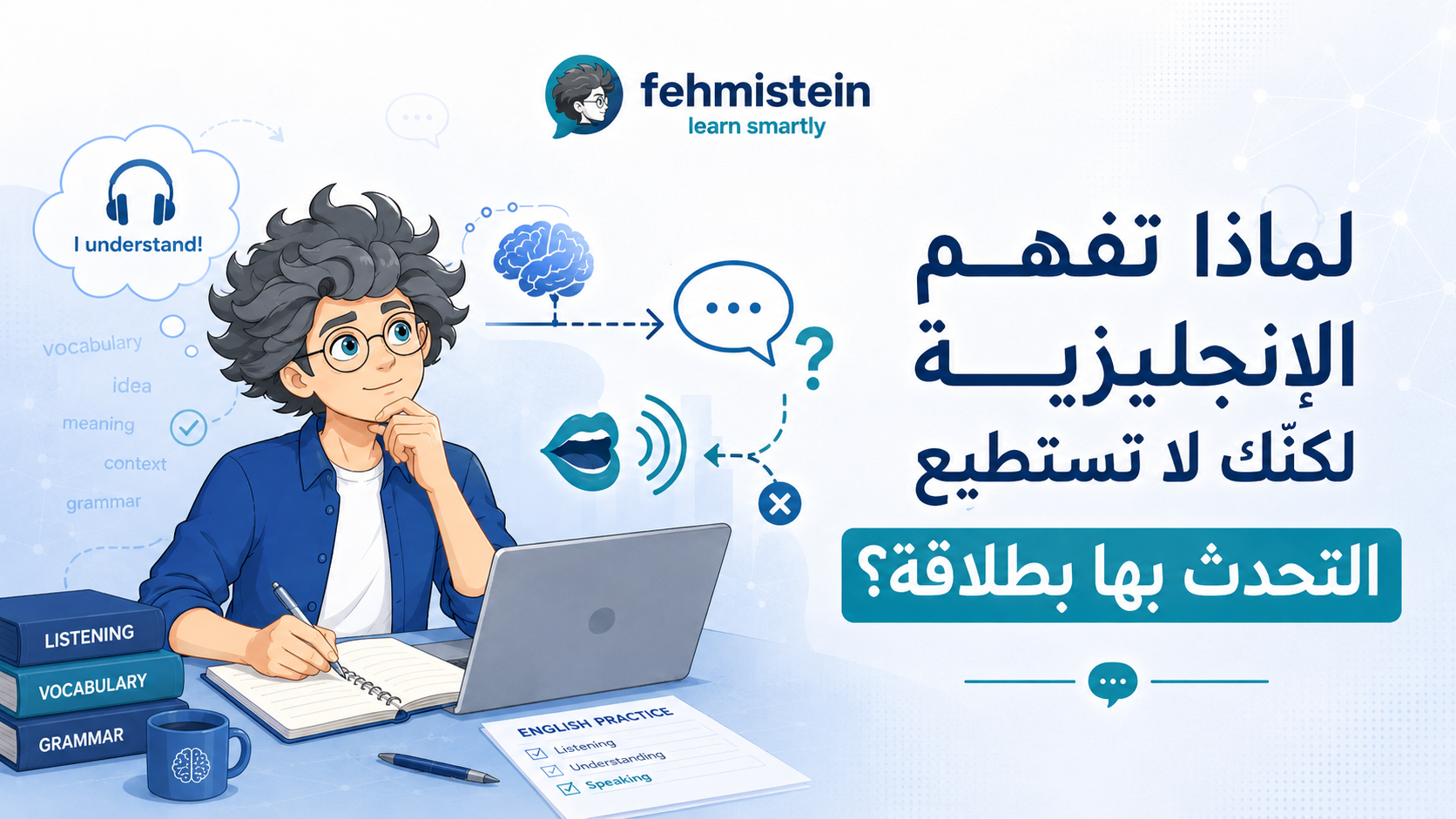
Why Can You Understand English but Not Speak It Fluently?
You Understand English but Cannot Speak Fluently? Discover the real reasons behind this gap and learn practical steps to turn your knowledge into fluent speech with Fehmistein by EZ Academy.
Introduction: You Know English, but the Words Disappear When You Speak
You may understand most of what you hear, read texts and articles without difficulty, and know many grammar rules and vocabulary items. However, when someone starts speaking to you in English, you may feel as if the words suddenly disappear.
You know what you want to say, but you need time to organize the sentence. You begin translating from Arabic, then hesitate because you are afraid of making a grammatical or pronunciation mistake.
This problem is very common among language learners. It does not necessarily mean that you do not know English. In most cases, it means that your receptive skills have developed more than your productive skills. This is exactly what we will address in this article from Fehmistein.
What Is the Difference Between Understanding and Using English?
Language skills can be divided into two categories:
- Receptive skills—reading and listening: You receive the language and try to understand its meaning. Context helps you predict words, even when you do not understand every detail.
- Productive skills—writing and speaking: You must recall vocabulary, construct sentences, and organize your ideas independently without relying on context.
That is why you may recognize a word when you hear it but fail to remember it when you need it during a conversation. The more your learning depends on reading and memorization rather than actual practice, the wider the gap becomes between what you understand and what you can use.
Why Is Speaking More Difficult Than Reading and Listening?
While reading, you can stop and reread a sentence. While listening, you can replay the recording. In a conversation, however, you must perform several tasks simultaneously within a few seconds:
- Understand what the other person is saying.
- Decide what you want to express.
- Choose the appropriate vocabulary.
- Construct the sentence.
- Control your pronunciation.
- Continue speaking without long pauses.
This simultaneous pressure slows down the retrieval of knowledge that has not been sufficiently practiced. It also increases hesitation, even among learners who have a good reading level.
Ten Reasons You Cannot Speak English Fluently
1. Your Vocabulary Is Passive
Vocabulary can be divided into two types:
- Passive vocabulary: Words you understand but cannot use automatically.
- Active vocabulary: Words you can recall and use while speaking.
You may know thousands of words passively but use only a limited number of them. The problem is not always learning new words; it is activating the words you already know.
Solution: Do not memorize words in isolation. Use them in sentences connected to your life and in different situations.
2. You Rely on Translation While Speaking
When you first construct a sentence in Arabic and then translate it into English, your response goes through additional stages that cause pauses and hesitation.
Solution: Start by using simple sentences that you can produce directly. Fluency begins with speed and clarity, while accuracy and complexity develop gradually.
3. You Are Afraid of Making Mistakes
Fear of using the wrong tense, mispronouncing a word, or stopping halfway through a sentence can make your speech slower and more stressful.
However, mistakes are not evidence of failure. They provide information about what you need to improve. At the early stages, prioritize expressing your idea clearly and continuing the conversation.
4. You Focus on Grammar More Than Communication
Analyzing every grammar rule while speaking can completely interrupt your speech.
The solution is not to ignore grammar, but to turn grammar into repeated patterns that you can use automatically through practice in real situations.
5. You Do Not Practice Speaking Enough
Watching English content for two hours a day does not guarantee that you will be able to produce the language. If your goal is fluency, your schedule must include real speaking practice.
You can describe what you see around you, summarize a video you watched, or record a short audio diary. Ten minutes of active language production every day can be more useful than an additional hour of silent watching. Regular speaking activities and useful phrases are also recommended by language-learning resources such as the British Council.learnenglish.britishcouncil
6. You Try to Use Sentences That Are Too Complex for Your Level
Fluency does not mean using the most difficult words. It means expressing yourself clearly and continuously.
Begin with structures you can use confidently, then gradually develop your responses from short answers into more detailed ones.
7. You Memorize Individual Words Instead of Phrases
Speakers do not construct every sentence word by word. They rely on useful expressions such as:
- “In my opinion…”
- “It depends on…”
- “What I mean is…”
These expressions give you time to organize your response and help you connect your ideas naturally.
Instead of memorizing ten separate words, learn five phrases that you can use immediately.
8. You Are Not Exposed to Natural Pronunciation Enough
Casual listening is not enough. Pay attention to how the speaker pronounces the entire phrase, where they place stress, and how they connect words.
Then imitate the pronunciation and rhythm—not just the individual words.
9. You Do Not Review Your Recordings
While speaking, you may not notice repeated problems such as long pauses, excessive hesitation words, or weak organization of ideas.
Audio recordings give you an objective view of your performance. Listen to each recording twice:
- The first time, listen for general understanding.
- The second time, analyze clarity, speed, and pronunciation.
Do not correct every mistake at once. Choose one or two problems to focus on in each session.
10. You Wait to Feel Confident Before You Start
Confidence does not come before practice. It grows through practice.
Every time you speak despite your hesitation, your ability to recall words becomes faster. Do not wait until your English is perfect. Start with the language you have now.
Does Fluency Mean Speaking Without Mistakes?
Fluency does not mean speaking extremely quickly or making no mistakes at all. In practical terms, fluency means being able to:
- Continue speaking without long pauses.
- Express ideas clearly.
- Connect sentences understandably.
- Use available vocabulary flexibly.
The goal is to achieve a balance between fluency, accuracy, and clarity.
How Can You Start Thinking in English?
Thinking in English does not happen through a sudden decision. It develops when you connect words directly to situations instead of connecting them to translation.
Start by describing simple things around you. Ask yourself everyday questions in English:
- What am I doing today?
- What did I learn?
- What was the best moment of my day?
When you forget a word, explain its meaning instead of stopping. For example:
“It is a tool you use to open a bottle.”
A Practical Plan to Improve Your English Speaking
Stage One: Build Fast Sentences
Create quick sentences about simple everyday topics. The goal is to reduce the time you spend translating.
Stage Two: Expand Your Answers
Use the following structure:
Main idea + reason + example + result
Stage Three: Learn Functional Expressions
Learn phrases for:
- Giving an opinion.
- Providing a reason.
- Making comparisons.
- Clarifying an idea.
Use these expressions in conversations instead of simply memorizing them.
Stage Four: Record and Analyze Yourself
Record a one- to two-minute answer. Analyze your clarity, pauses, and vocabulary, then record the answer again.
The second attempt helps turn your observations into real improvement.
Stage Five: Speak Within a Time Limit
Speaking within a specific time limit is useful for both academic life and exams such as IELTS and TOEFL.
Six Effective Speaking Exercises
1. Shadowing
Listen to a sentence, replay it, and repeat it in the same way. Focus on rhythm and intonation. Record yourself and compare your pronunciation with the original speaker.
2. Retelling
Listen to a story or watch a short video, then explain it in your own words. Do not try to repeat the original text word for word.
3. The One-Minute Exercise
Choose a question and speak about it for one minute without stopping. If you forget a word, explain it instead of returning to Arabic.
4. Progressive Questions
Start with a simple question, then ask deeper questions about the same topic.
5. Answer in Three Ways
Answer the same question in three forms:
- A short answer.
- A medium-length answer.
- A more detailed answer.
This helps you control the length of your responses.
6. New Vocabulary Practice
Choose five new words or phrases and use all of them in one audio recording within a natural context.
How Is Fluency Connected to IELTS and TOEFL?
In IELTS Speaking, giving memorized answers is not enough. You need to understand the question, develop your ideas, use suitable vocabulary, and continue speaking without excessive pauses.
If you understand English but do not use it regularly, you may know the answer in your mind but struggle to produce it during the interview.
In TOEFL Speaking, you also need to listen to or read information first, then summarize the main ideas orally within a specific time limit. This requires you to combine language, organization, and speed simultaneously.
Therefore, your preparation for these exams should include real speaking practice—not just silent study of questions.
You can explore the available exam preparation tracks on Fehmistein to find training that matches your level and goals.
Suggested Weekly Speaking Routine
Every Day
- 10 minutes of active listening.
- 10 minutes of pronunciation imitation.
- 10 minutes of speaking or recording.
- Review five useful phrases.
Three Times a Week
- Give an extended answer on a specific topic.
- Review your recording.
- Repeat the answer after analyzing your performance.
Once a Week
- Have a longer conversation or complete a speaking mock test.
- Analyze pauses and mistakes.
- Set a goal for the following week.
Consistency is more important than completing one long session and then stopping for several days.
When Do You Need a Language Course?
You may need a language course or a foundation stage if:
- You cannot construct a simple sentence.
- You translate most of what you want to say.
- You have clear gaps in grammar and vocabulary.
However, if you understand most content and can express your ideas but hesitate during tests or do not know how to organize your answers, you may be ready for direct IELTS or TOEFL training.
To determine which option you need, start with a free placement test from Fehmistein and explore the available training packages.
For a free educational consultation, contact the EZ Academy team via WhatsApp: +90 552 574 12 76.
Frequently Asked Questions
Why do I understand English but cannot speak it?
Your receptive skills may have developed more than your productive skills. You may not have received enough practice recalling words and constructing sentences quickly during conversations.
Is a lack of vocabulary always the reason?
No. You may know many words passively but have not practiced using them in different sentences and situations.
How can I stop translating?
Use simple sentences, describe your day in English, and learn phrases within context instead of translating every individual word.
How can I practice speaking if I do not have a conversation partner?
Use audio recordings, shadowing, retelling, daily descriptions, and answering questions aloud.
Is watching movies enough to improve speaking?
Watching movies can help with listening and vocabulary, but it is not enough unless you turn the content into imitation, summaries, and active use.
Turn What You Know into Language You Can Use
Understanding English is an important first step, but it does not automatically become fluency. To speak with greater confidence, you need to activate your vocabulary, reduce translation, practice aloud, record your answers, review your mistakes, and use phrases in real situations.
Do not make your goal speaking without any mistakes. Start by expressing your ideas clearly, then gradually improve your accuracy, vocabulary, and pronunciation.
👉 Start your free trial on Fehmistein today
Prepared by: The Educational Content Team — EZ Academy and Fehmistein
Similar Articles