IELTS Exam 2026: Strategies for the Four Skills | EZ Academy
A comprehensive guide to passing the IELTS 2026 exam. Professional strategies for writing, speaking, reading, and listening. Start your preparation and achieve 7+ now →
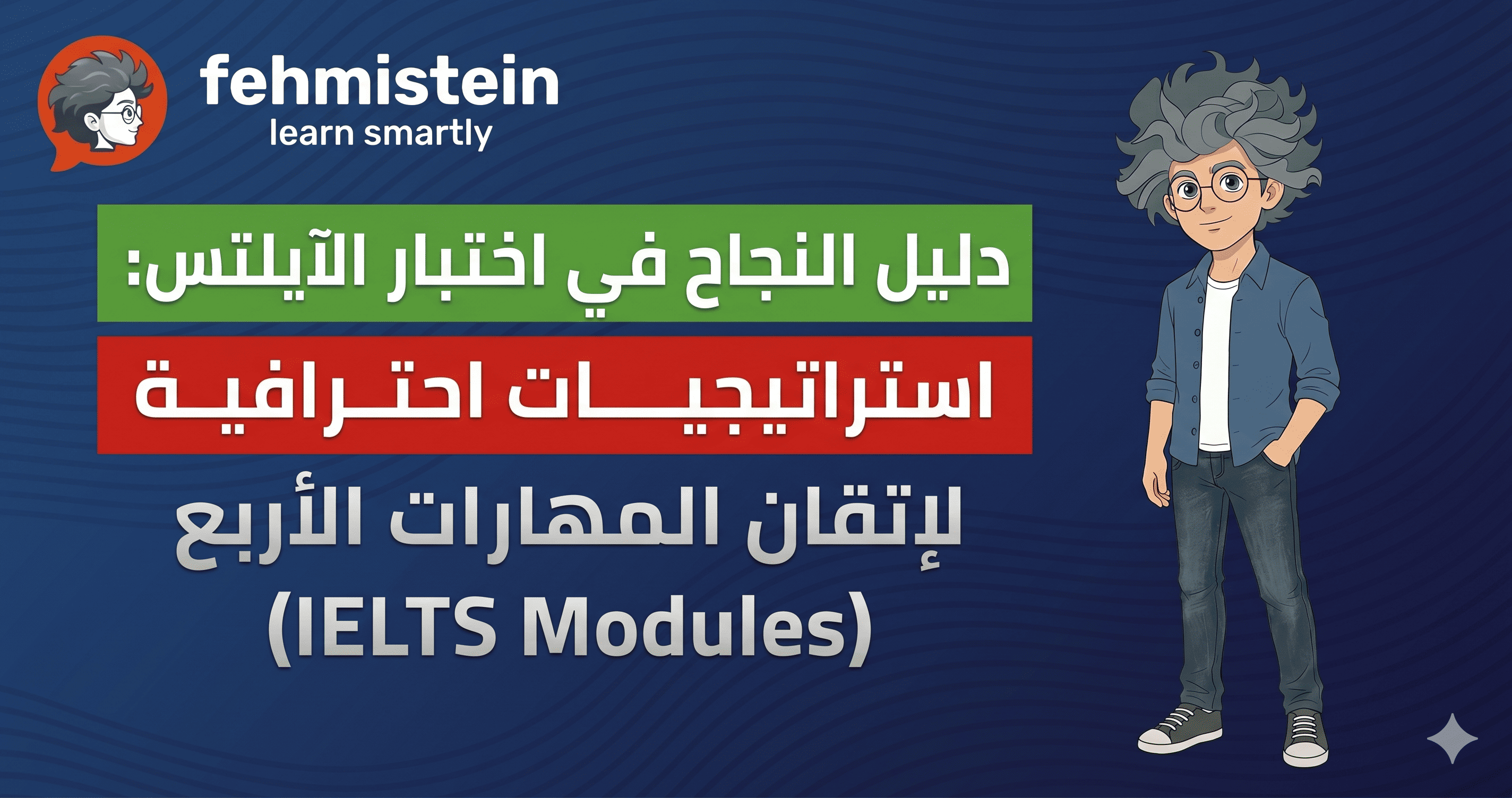
IELTS 2026: A Complete Guide to Excelling in the Four Skills
The IELTS (International English Language Testing System) is your main gateway to achieving your academic and professional ambitions on a global level. Whether you aim to study abroad, immigrate, or secure an international job opportunity, achieving a suitable IELTS score opens countless doors.
In this comprehensive guide, you will learn professional strategies for each of the four sections of the test, along with the most important mistakes you should avoid.
If you are wondering about the difference between IELTS and other international tests such as TOEFL or YÖS, you can read:
Comprehensive TR-YÖS Guide for Arab Students
What is IELTS and What Are Its Types?
IELTS is an international English proficiency test accepted by more than 11,000 institutions worldwide. It is available in two versions:
- Academic IELTS: for university applications and higher education.
- General Training IELTS: for immigration, work, and training programs.
The test consists of four sections: Listening, Reading, Writing, and Speaking. Scores range from 0 to 9, and most universities require a score of 6.5 or higher.
Before starting your preparation, it is recommended to assess your current level through:
Free Placement Tests on EZ Academy
The Four IELTS Skills and How to Excel in Each
1. IELTS Writing — Structuring Ideas, Not Just Words
Academic writing in IELTS is not just about producing sentences; it is about structuring ideas effectively. Task 2 is evaluated based on four criteria: task response, coherence and cohesion, lexical resource, and grammatical accuracy.
Professional strategies:
- Use the PEEL structure (Point, Evidence, Explanation, Link).
- Avoid unnecessary length; precise sentences are better than long, error-filled ones.
- Use academic linking words such as “Moreover,” “Conversely,” “Consequently,” and “Nevertheless.”
- Spend 3–5 minutes planning before writing.
2. IELTS Speaking — Confidence Over Perfection
The key in the speaking test is that examiners evaluate your ability to communicate fluently and confidently, not whether your opinions are correct.
Professional strategies:
- Expand your answers instead of giving short responses.
- Use natural fillers such as: “That’s an interesting question, let me think for a second.”
- Vary your tone and avoid speaking in a monotone.
3. IELTS Reading — Smart Time Management
Your biggest challenge in reading is time, not difficulty.
Professional strategies:
- Use skimming: read the title and first/last lines of paragraphs quickly.
- Use scanning: look for keywords like names, dates, and numbers.
- Understand question types (True/False/Not Given vs Matching Headings).
- Spend about 20 minutes per passage.
4. IELTS Listening — Avoid Common Traps
Listening requires full concentration, and examiners often include traps.
Professional strategies:
- Watch for corrections (e.g., “5… actually 6”).
- Predict the type of answer before listening.
- Focus on meaning rather than exact words (paraphrasing).
Common IELTS Preparation Mistakes
Poor preparation wastes time and effort. Avoid these:
- Studying without a structured plan.
- Ignoring writing practice until the last moment.
- Not practicing real exams under timed conditions:
- Practice Tests on EZ Academy
- Ignoring basic English skills. Start here if needed:
- Learn English in 30 Days
If you feel overwhelmed, read:
Using AI Tools for IELTS Preparation
AI tools have become essential in test preparation. Learn more:
Top 10 AI Tools for Students 2026
How Long Do You Need to Prepare?
- Beginner: 6+ months
- Intermediate: 3–6 months
- Upper-intermediate: 2–3 months
- Advanced: 1–2 months
Frequently Asked Questions
What is the difference between Academic and General IELTS?
Academic is for university studies; General is for immigration and work. Listening and Speaking are the same, while Reading and Writing differ.
How many times can I take IELTS?
You can take it as many times as you want, but it is recommended to wait at least one month between attempts.
How long is the IELTS score valid?
Two years.
What score do universities require?
Typically between 6.0 and 7.5, with scientific and medical programs often requiring 7.0 or higher.
Does burnout affect IELTS performance?
Yes, significantly. If needed, read:
Conclusion: Your Path to Band 7+ Starts Here
Success in IELTS is a matter of strategy as much as language ability. Students who understand how to approach the exam intelligently outperform those who rely only on memorization.
Start by defining your target score, create a structured study plan, and practice consistently with real tests.
To begin your preparation journey, visit:
and explore the available
study packages to start today.
Similar Articles