IELTS on Computer in 2026: What Has Changed Since the Discontinuation of the Paper-Based Test?
Learn About IELTS on Computer Changes in 2026 After the Paper-Based Test Was Discontinued, What Remains the Same, the Writing on Paper Option, Results, and a Preparation Plan
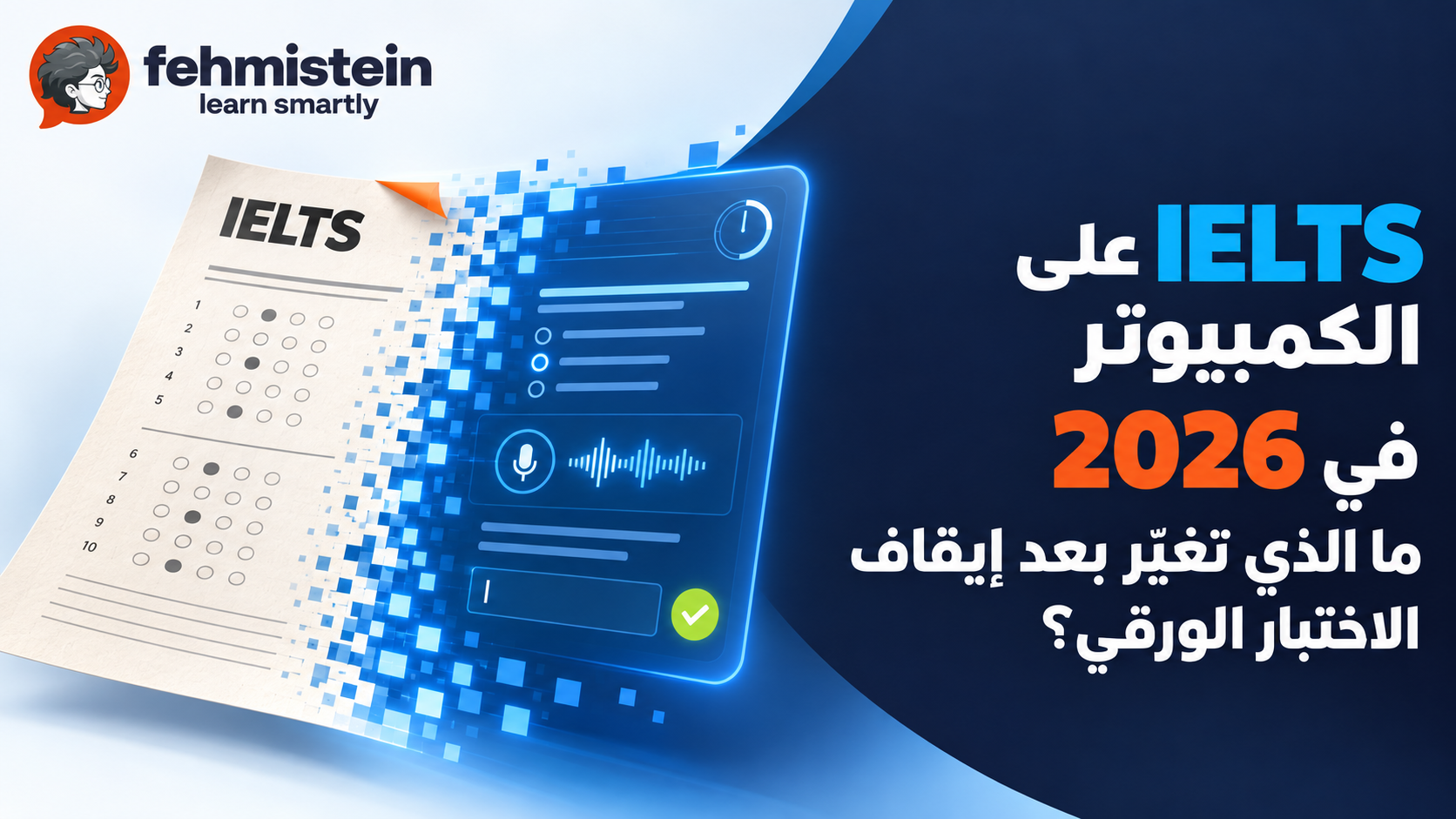
IELTS on Computer has become the primary format for taking the test worldwide in 2026, following the announcement by IELTS partners that the full paper-based version would be discontinued from mid-year. However, this shift does not mean the test level, question types, or scoring method have changed; it primarily concerns how questions are displayed and answers are entered.
So what has actually changed? Has IELTS become more difficult? And how should you adjust your preparation method? Here is the precise answer based on the latest official information.
Quick Summary
IELTS officially announced that it will no longer offer the test in its full paper-based format after mid-2026, and that IELTS tests will be delivered on computer, with the exact implementation date varying from one country to another.
After this change:
- Listening, Reading, and Writing questions are displayed on a computer screen.
- Answers are entered using a keyboard and mouse.
- The Speaking test remains a face-to-face interview with an IELTS examiner.
- The skills measured, marking criteria, and 1–9 band scale remain unchanged.
- IELTS on Computer results are usually released within a shorter period.
- A Writing on Paper option is available in specific markets and centers for those who prefer to write the Writing section by hand.
- Results from previous paper-based tests remain valid for the recommended validity period.
The official IELTS announcement regarding the updated test delivery method confirmed that the exact transition timeline differs by market. Therefore, you must verify the available options in your country and center before booking.
Has Paper-Based IELTS Been Completely Discontinued in 2026?
Yes. The full paper-based IELTS format has been discontinued as a standard option, and the test has moved to computer-based delivery starting from mid-2026. However, two points should be noted:
First, the transition was not implemented on the same day in all countries; IELTS clarified that exact dates differ by market.
Second, some centers in specific markets began offering a hybrid format called IELTS on Computer – Writing on Paper. In this format, the test-taker completes Listening and Reading on computer, while writing the two Writing-section answers by pen on an official answer sheet.
You can use the official IELTS Test Centre search tool to verify available formats and dates in your city.
What Changed in IELTS on Computer in 2026?
The main change is the method of test delivery, not the test itself. Instead of dealing with a question booklet and answer sheet, the test-taker uses a digital interface inside an approved test center.
- Listening: Previously had questions and answers on paper; now questions and answers are on screen.
- Reading: Previously used printed texts and an answer sheet; now uses digital texts and direct answer entry.
- Writing: Previously required handwriting both tasks; now requires typing both tasks using a keyboard.
- Speaking: Remained a direct interview with an examiner in both formats, without change.
Results also changed: they previously usually took longer, but are now usually released within 1–2 days. One Skill Retake was not previously linked to the paper-based test and is now available, under conditions, at centers that offer it. For more details, see our article: IELTS One Skill Retake: When Can You Retake One Skill?
The method of taking notes also changed: it was previously done by pen on the question booklet, and is now done through the tools available in the digital interface. The band scale remains exactly the same: from 1 to 9, with no change.
1. Writing Has Become Both a Language and Digital Skill
In the full computer-based format, you must type both Writing Task 1 and Writing Task 2 using a keyboard. The examiner does not assess typing speed itself, but very slow typing or frequent typing errors can consume time you need for planning and reviewing.
Therefore, it is not enough to write good IELTS essays on paper. You should also train on:
- Typing in English at a comfortable speed.
- Using punctuation accurately.
- Editing sentences and paragraphs without wasting time.
- Reviewing spelling and grammar errors on screen.
- Completing both tasks within 60 minutes.
The appearance of the text on a computer does not mean there is an automatic spell-checker you can rely on. Treat the test as if the responsibility for detecting every error is entirely yours.
2. Reading on Screen Has Become Part of Performance
The content of the Reading section has not become more difficult, but the way you handle it has changed. You will read texts and questions on screen instead of flipping through printed pages. Therefore, you need to train on:
- Tracking the location of information within digital texts.
- Moving systematically between questions and paragraphs.
- Using the highlighting or note-taking tool if available in the interface.
- Maintaining focus while reading long texts on screen.
- Entering answers in the required format without typing errors.
A student may know the correct answer but lose marks because of writing an incomplete word or exceeding the required word limit. Therefore, training must include accuracy in entering answers, not only language comprehension.
3. Listening Now Depends on Entering Answers Directly
In IELTS on Computer, you listen to recordings and enter your answers in the designated fields on screen. This makes formatting and the speed of moving between questions important factors.
During practice, get used to:
- Reading questions before the audio begins.
- Typing while listening without losing focus.
- Checking singular and plural forms.
- Reviewing the spelling of names and numbers.
- Following instructions such as NO MORE THAN TWO WORDS.
Do not assume you will have a long time at the end of the section to transfer answers written elsewhere. It is better to train according to the actual digital interface and timing.
4. Results Are Faster in Most Cases
According to the official IELTS test delivery methods page, IELTS on Computer results usually appear within one to two days after completing the test.
IELTS states that approximately 80% of computer-based test results are now available within two days, and nearly half are released within one day, based on its published global data. However, some results may require additional time for verification procedures. You can review details on the IELTS fast results page.
For the Writing on Paper format, results are released, according to the official page, within up to five days.
What Has Not Changed in IELTS After the Paper Version Was Discontinued?
This is the most important point students should know: IELTS on Computer is not a new test and is not an easier or harder version of the paper-based test.
IELTS confirmed that the transition does not change the skills measured, test structure, or how results are interpreted. The following remain the same:
Test Types
- IELTS Academic continues to be used for university study, postgraduate study, and some professional registration purposes.
- IELTS General Training continues to be used for immigration, work, and some training and non-university education programs.
- IELTS for UKVI is used when a UKVI-approved test is required for specific UK visa and immigration purposes.
To learn the detailed difference between Academic and General Training, see our article: IELTS Academic or General Training? The Difference and How to Choose.
The Four Skills
The test still measures Listening, Reading, Writing, and Speaking. Listening and Speaking remain similar in Academic and General Training, while Reading and Writing materials differ between the two versions.
The official IELTS Academic test format clarifies that the test consists of the four skills and takes approximately two hours and 45 minutes in total.
Band Scale and Assessment Criteria
Scores are still awarded according to the well-known IELTS scale from Band 1 to Band 9, in whole or half bands such as 6.5 and 7.5. In Writing, responses are still assessed according to the same core criteria, including:
- Task achievement/response.
- Coherence and cohesion.
- Lexical resource.
- Grammatical range and accuracy.
To learn how the overall score is calculated in detail, review our article: How Is IELTS Score Calculated? Overall Band Explained with Examples.
A student does not receive a higher score because they type quickly, nor does their score decrease simply because they used a computer. Assessment is based on the quality of language and response, not the medium used to write it.
Speaking Test
The Speaking section remains a live interaction with a trained IELTS examiner, not a series of pre-recorded answers assessed by an automated program. The meeting may be in person or through a live video call inside the test center, depending on the center’s arrangements, but it remains a live conversation with an examiner.
What Is the Writing on Paper Option?
Writing on Paper is a format designed for test-takers who prefer to write the Writing section by hand, even though the rest of the test has moved to computer.
In this format:
- Listening is taken on computer.
- Reading is taken on computer.
- Both Writing tasks appear on screen, but answers are written by pen on an official answer sheet.
- This format is not mentioned on the Test Report Form (TRF).
- Results are released within up to five days.
However, this option is not available in all countries or centers. The IELTS on Computer and Writing on Paper page confirms the need to check local availability.
Also, SELT tests for UK visa and immigration purposes will be available only in the fully digital format, according to the official announcement.
Are Previous Paper-Based IELTS Results Still Valid?
Yes. Discontinuing the paper-based test does not cancel scores issued from it.
IELTS confirmed that results from current paper-based tests are not affected and remain valid until the end of the recommended validity period, which is usually two years from the test date. Therefore, you do not need to retake the test simply because you received your result from a paper-based version.
The final decision regarding score acceptance and validity remains with the university, immigration authority, or institution you are applying to. Therefore, always check their direct requirements.
Is IELTS on Computer Harder Than the Paper-Based Test?
No. The difficulty level, question types, marking criteria, and band scale have not changed.
However, the digital format may feel more difficult for a student who has not trained on it, especially if they:
- Type slowly in English.
- Lose focus when reading long texts on screen.
- Make frequent typing errors.
- Do not know how to manage time within the interface.
- Rely on making many lines and notes on paper.
On the other hand, some students may find it more comfortable because of the ease of editing text, screen clarity, direct answer entry, and faster results.
Therefore, the real difference is not in question difficulty, but in how prepared you are for the delivery method.
What Is the Relationship Between One Skill Retake and the Computer-Based Test?
The IELTS One Skill Retake service allows you to retake only one skill—Listening, Reading, Writing, or Speaking—instead of retaking the full test.
According to the official One Skill Retake conditions, you must:
- Have taken a full IELTS test on computer.
- Have taken the test at a center participating in the service.
- Take the skill retake within 60 days of the original test.
- Use the service only once for each full test.
You will then receive a new Test Report Form that includes the new score for the retaken skill and the original scores for the other three skills. You can choose to use either the original or new report.
However, do not assume that your university or immigration authority automatically accepts One Skill Retake. Check the receiving institution before booking, because acceptance policies differ. Full details and conditions are available in our article: IELTS One Skill Retake: When Can You Retake One Skill?
How to Prepare for IELTS on Computer in 2026?
1. Start with a Digital Diagnostic Mock Test
Take a practice test on computer before creating your study plan. The goal is not only to know your approximate score, but to identify practical issues such as slow typing, weak screen focus, answer-entry errors, poor time distribution, and difficulty reviewing an essay digitally.
You can start with a mock IELTS test on the Fehmistein platform.
2. Train on the Interface, Not Only PDF Files
Books and PDF files remain useful for learning strategies, but they are not enough on their own. Dedicate a significant part of your training to simulating the actual test experience on screen.
Use official IELTS practice materials to become familiar with question types, then apply them in timed digital training.
3. Increase Typing Speed Without Sacrificing Accuracy
There is no mandatory typing speed, but you should be able to write a complete answer and review it within the time limit. Train on writing coherent English paragraphs while focusing on:
- Accuracy before speed.
- Reducing the need to look at the keyboard.
- Using punctuation.
- Detecting errors without an automatic checker.
- Leaving time for final review.
4. Use a Timer That Simulates Each Section’s Time
Open-ended practice does not reveal time-management problems. Complete full sessions according to official timing:
- Listening: approximately 30 minutes.
- Reading: 60 minutes.
- Writing: 60 minutes.
- Speaking: 11–14 minutes.
5. Review Error Causes, Not Only the Number of Correct Answers
After each practice session, classify your errors as:
- Comprehension error.
- Spelling error.
- Exceeding the word limit.
- Correct answer entered in the wrong place.
- Weak time management.
- Distraction caused by how the text is displayed on screen.
This analysis is more useful than repeating many practice tests without knowing why marks were lost.
Four-Week Digital Training Plan
Week 1: Determine Level and Get Used to the Interface
Take a diagnostic test and analyze your errors.
Week 2: Improve Digital Reading and Listening
Complete timed practice sessions with direct answer entry.
Week 3: Develop Keyboard-Based Writing
Write both Writing tasks on alternate days, followed by language review.
Week 4: Simulate the Test Experience
Complete two full tests, then analyze performance and time management.
Through Fehmistein, you can organize your training according to your level, progress through question types, train in a digital environment, and review solutions and analyze strengths and weaknesses instead of relying on random study.
Start your training with a free trial on Fehmistein.
Common Mistakes After Moving to IELTS on Computer
- Relying on paper-based training until test day. Knowing the content alone does not guarantee the ability to work quickly with the screen and digital fields. Make the digital format a fixed part of your preparation.
- Focusing on typing speed while neglecting language quality. Fast typing does not compensate for weak ideas or grammatical errors. You need speed that allows you to plan, write, and review—not simply produce many words.
- Writing short answers in Reading and Listening without following instructions. You must follow the specified word limit and pay attention to spelling, singular and plural forms. An answer close to correct does not necessarily receive the mark.
- Booking One Skill Retake before verifying acceptance. Confirm that the service is available at your center and that the receiving university or institution accepts its result.
- Assuming IELTS on Computer means taking the test from home. IELTS on Computer is usually taken inside an official IELTS center. IELTS Online is a different option, available for Academic only in certain countries, and receiving institutions decide whether to accept its results. If the test is for visa purposes, it usually must be taken in person according to the required test type.
Frequently Asked Questions About IELTS on Computer in 2026
When was paper-based IELTS discontinued?
IELTS announced the discontinuation of the full paper-based version starting from mid-2026, with the exact date differing by country and market. Check your local IELTS center to confirm the final situation in your region.
Have IELTS questions changed in 2026?
No. The announced change concerns the test delivery method. The skills measured, basic structure, and score interpretation have not changed.
Is IELTS on Computer easier?
It is neither easier nor harder in terms of content and assessment. It may be more suitable for those who type and read quickly on screen, and it may require additional training for those who prefer paper.
Has the Speaking section moved to computer?
Speaking remains a live interview with a trained examiner. It does not turn into recorded answers corrected by a computer.
Can I write the Writing section on paper?
Yes, but only if your center offers the IELTS on Computer – Writing on Paper option. This option is available in specific markets and centers, not for all test-takers.
When do IELTS on Computer results appear?
Results usually appear within one to two days, while the Writing on Paper format may take up to five days. Some results may be delayed if additional verification is needed.
Can I use spell-check in the Writing section?
You should not rely on the presence of a spelling or grammar checker. Train yourself to detect your own errors and review the text within the allotted time.
Can I return to previous questions?
The interface usually allows navigation within the section according to how the test works, but you should practice with the official digital model and learn the interface functions before test day instead of discovering them during the exam.
Is an old paper-based IELTS result still accepted?
Yes. Previous paper-based results are not affected by the decision to discontinue the paper format and remain valid for the validity period accepted by the receiving institution, usually two years.
Conclusion: Change Your Training Method, Not Only Your Language Strategy
The most important change in IELTS on Computer in 2026 is the move of Listening, Reading, and Writing into a digital environment, while test content, difficulty level, marking criteria, and the band scale remain unchanged.
A student who is linguistically prepared but has not trained on screen may lose time and marks due to slow typing or entry errors. Therefore, your plan should combine language development, understanding question types, and regular practice in a digital environment that simulates the real test.
For a free educational consultation about preparing for IELTS, contact the EZ Academy team via WhatsApp:
Phone: +90 552 574 12 76
Direct link: https://wa.me/905525741276
Similar Articles