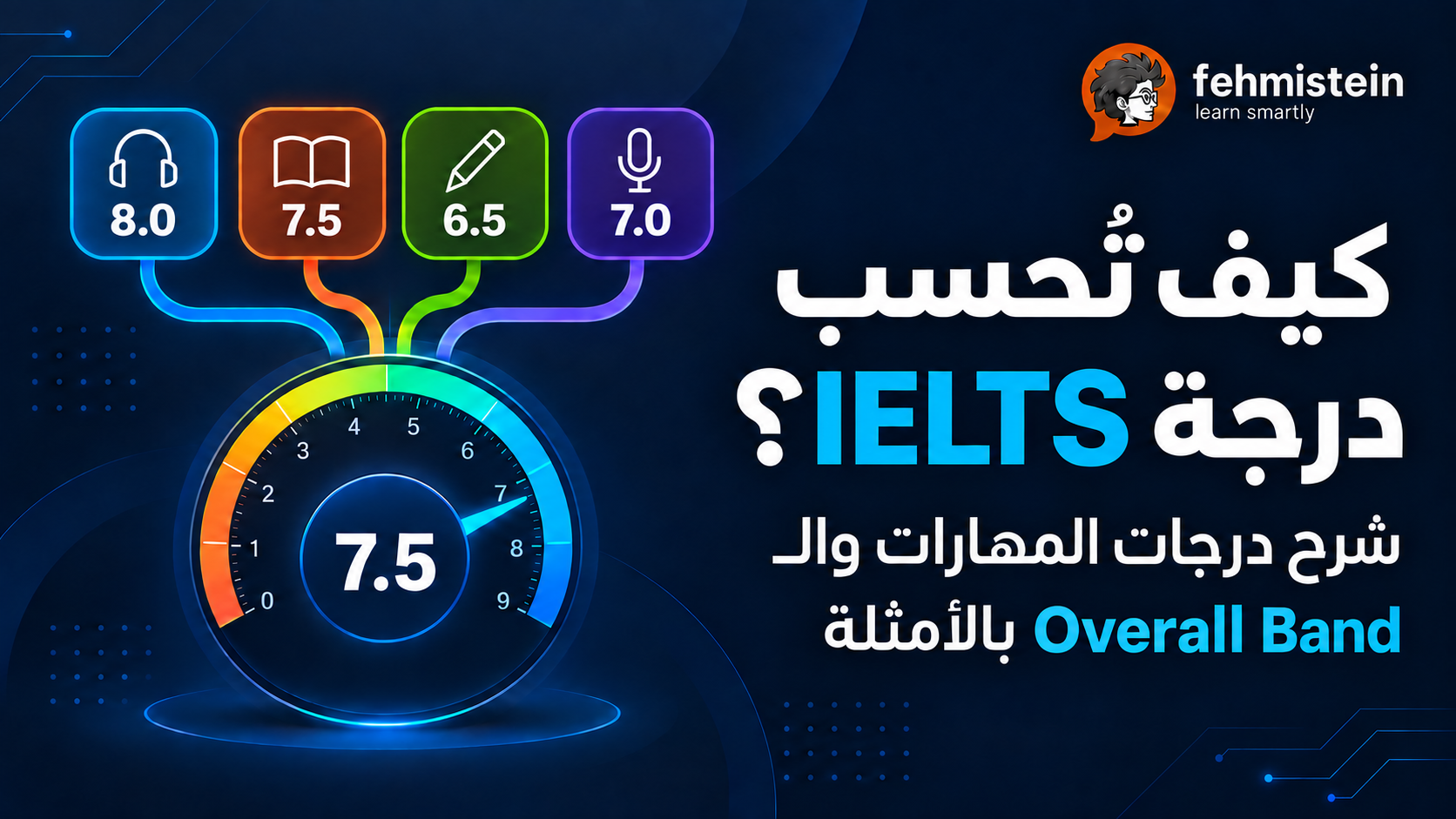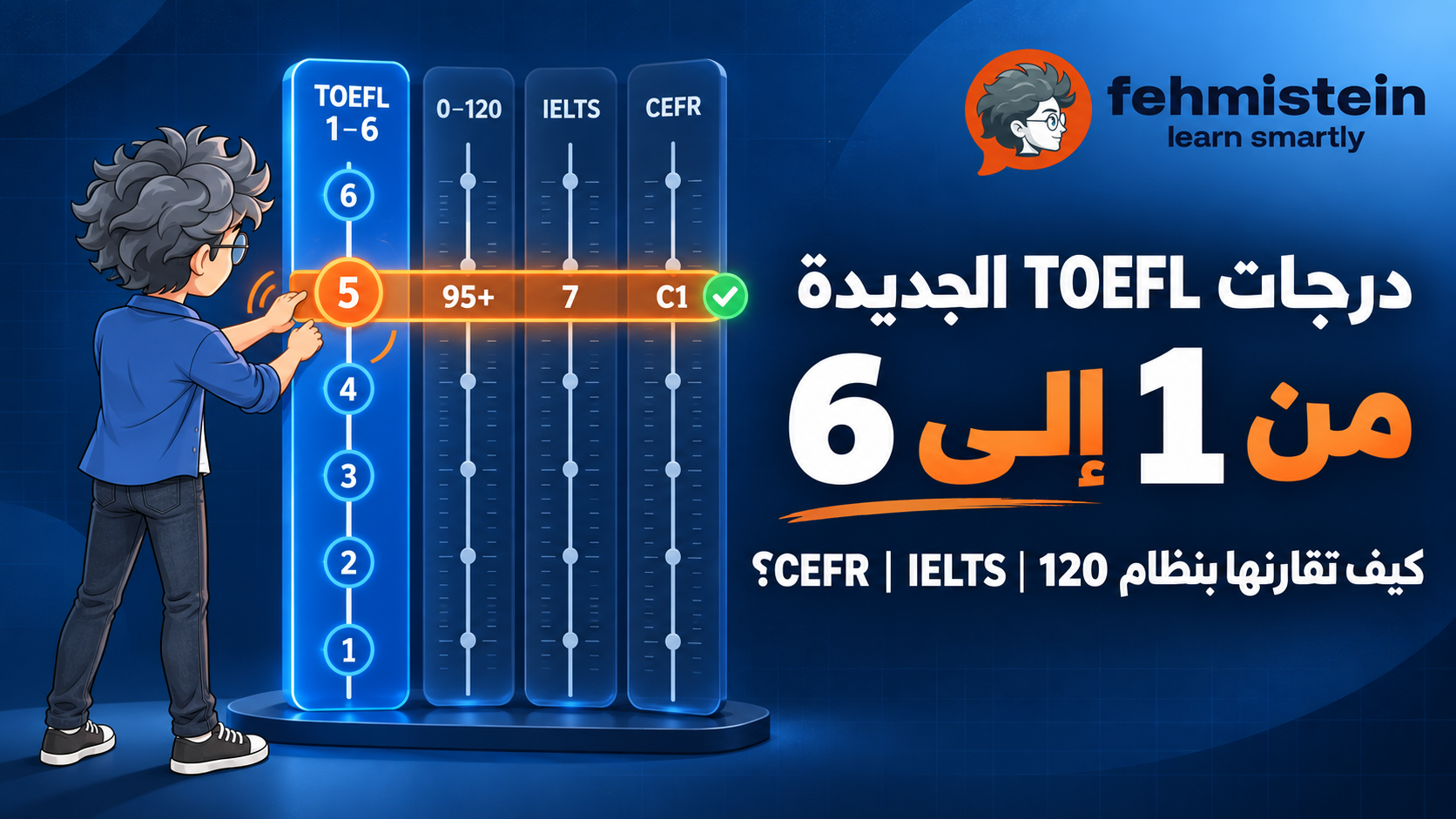
The New TOEFL Scoring Scale (1–6): How Does It Compare to the 120-Point System, IELTS, and CEFR?
Discover the New TOEFL Scoring System from 1 to 6, How the Overall Score Is Calculated and Converted to the 120 Scale, and Compare It with IELTS and CEFR Levels via Official Tables
Starting January 21, 2026, the TOEFL iBT test began using a new scoring scale from 1 to 6 in half-point increments, instead of relying exclusively on the previous 0–120 system. Test-takers now receive an independent score for each of Reading, Listening, Writing, and Speaking, in addition to an Overall Score calculated from the average of the four skills.
The new system is designed to be clearer when compared to CEFR levels and other test scores. However, converting between new TOEFL scores (1–6) and the old system or IELTS is not a simple multiplication process; each band on the 1–6 scale corresponds to a range of old scores, and comparison with IELTS differs across skills.
Quick Summary
According to the official TOEFL score explanation from ETS:
- The new scale was implemented on January 21, 2026.
- New TOEFL scores range from 1 to 6, appearing in 0.5 increments such as 4.0, 4.5, 5.0.
- Students receive a score for each skill and an Overall Score, calculated from the average of the four skills.
- Band 4 corresponds to CEFR B2, Band 5 to C1, and Band 6 to C2.
- During a two-year transition period, the report also shows a comparative Overall Score on the old 0–120 scale. Test-takers do not need to manually convert their score when applying to a university that still uses the 120 system.
What Is the New TOEFL Scoring System?
The TOEFL report now displays a score for each of Reading, Listening, Writing, and Speaking, plus an Overall Score, all on a unified scale from 1 to 6.
Each score appears in half-point steps: 1, 1.5, 2, 2.5, 3, 3.5, 4, 4.5, 5, 5.5, 6.
This differs from the previous system, which gave each skill a score from 0 to 30, then summed the four scores for a total out of 120.
What Is the Difference Between the New and Old TOEFL Systems?
Key differences between the two systems:
- Skill score: Previously 0–30 per skill; now 1–6 per skill.
- Overall score: Previously 0–120; now 1–6.
- Overall calculation: Previously sum of four skill scores; now average of the four skills.
- Increments: Previously whole points; now half-points.
- CEFR alignment: Previously different boundaries per skill; now a unified number per level across all skills.
- Implementation: New system used since January 21, 2026; old system used before this date.
The main advantage of the new system is that the same number indicates the same CEFR level across all skills. Scoring 4 in Reading, Listening, Writing, or Speaking means performance in that skill aligns with B2.
In the old system, CEFR-related boundaries differed between skills; for example, the minimum for B2 was not the same number across all four sections.
The technical research published by ETS in April 2026 explains that the goal of the new scale is to make level interpretation more consistent and aligned with the European CEFR framework.
How Is the Overall TOEFL Score (1–6) Calculated?
The Overall Score is calculated by adding the four section scores and dividing by four:
Overall TOEFL Score = (Reading + Listening + Writing + Speaking) ÷ 4
Then the result is rounded to the nearest half band.
Example 1: Reading 5.0, Listening 4.5, Writing 4.0, Speaking 4.5.
Calculation: 5 + 4.5 + 4 + 4.5 = 18; 18 ÷ 4 = 4.5.
Overall TOEFL Score = 4.5.
Example 2: Reading 5.5, Listening 5.0, Writing 5.0, Speaking 5.0.
Calculation: 20.5 ÷ 4 = 5.125. According to ETS’s official example, 5.125 rounds to Overall Score = 5.0.
Example 3: Reading 5.5, Listening 5.5, Writing 5.0, Speaking 5.0.
Calculation: 21 ÷ 4 = 5.25; the average rounds up to the next half: Overall Score = 5.5.
Therefore, Overall Scores like 5.125 or 5.25 do not appear in the report; they are rounded to the nearest half band.
Table: Converting New TOEFL Scores (1–6) to the 120 Scale
There is no formula like “new score × 20 = old score.” This method is inaccurate because each new Band corresponds to a range of old scores, not a single number.
According to the official ETS table, each new score corresponds to the following range on the 120 scale:
- 6.0 → 114–120
- 5.5 → 107–113
- 5.0 → 95–106
- 4.5 → 86–94
- 4.0 → 72–85
- 3.5 → 58–71
- 3.0 → 44–57
- 2.5 → 34–43
- 2.0 → 24–33
- 1.5 → 12–23
- 1.0 → 0–11
Does Band 5 Equal 100 on the Old TOEFL?
Band 5 corresponds to a range starting from 95 up to 106, so an old score of 100 falls within Band 5.
ETS recommends that institutions which previously required the following common scores use the corresponding new boundaries:
- Old requirement 100 → New 5.0
- Old 90 → New 4.5
- Old 80 → New 4.0
- Old 70 → New 3.5
These are recommendations for institutions and do not mean every university will adopt the same boundary. You must check the program page and confirm current requirements. Full tables can be reviewed in the ETS institutional guide on the new TOEFL scale.
Why Can’t 1–6 Be Converted to 120 by Multiplication?
Because the new scale is divided into performance levels, while the old system was more granular numerically.
For example, old scores from 95 to 106 all represent the new Band 5. Therefore, there is no single old score that equals 5 absolutely.
Conversion also differs between skills; a new score of 5 in Reading corresponds approximately to an old range of 24–26, in Listening 22–25, in Writing 24–26, and in Speaking 25–26.
This variation is one reason why using the official ETS table is more accurate than any calculator based on multiplication or percentage.
What Appears in the TOEFL Report During the Transition Period?
To help students and universities transition to the new system, ETS clarifies that test reports issued after January 21, 2026 will display for two years:
- Skill scores and Overall Score from 1 to 6.
- CEFR level.
- A comparative Overall Score on the 0–120 scale.
The comparative score on the 120 scale represents approximately the midpoint of the corresponding old range, not a recalculation of the test using the old method.
What Should I Do If a University Still Requires 90 or 100?
You do not need to perform a conversion yourself. The ETS guide for test-takers clarifies that your official report also displays a comparative Overall Score out of 120 during the transition period.
You can submit the report as is, then contact the university if the admissions page has not yet been updated.
Comparing New TOEFL Scores with CEFR
The new scale is directly linked to CEFR levels:
- 6.0 → C2
- 5.5 → C1
- 5.0 → C1
- 4.5 → B2
- 4.0 → B2
- 3.5 → B1
- 3.0 → B1
- 2.5 → A2
- 2.0 → A2
- 1.5 → A1
- 1.0 → A1
What do these levels mean?
- A1: Very basic language use.
- A2: Ability to handle simple, familiar situations.
- B1: Independent language use in familiar topics.
- B2: Ability to understand more complex content and communicate independently.
- C1: Advanced and flexible language use in academic contexts.
- C2: Very high level of accuracy, understanding, and expression.
For university admission, many program requirements typically center around B2 or C1, but the university determines the appropriate score for its specialization and study level.
Does TOEFL Band 4 Mean B2 in All Skills?
Yes. One of the most important features of the new system is that the number carries the same meaning across sections. Scores of 4 or 4.5 in any of Reading, Listening, Writing, Speaking, or Overall mean B2 level. Scores of 5 and 5.5 relate to C1, and 6 relates to C2.
However, you must distinguish between general CEFR level and university requirements. A program may require Overall 4.5 with a minimum of 4 in each skill, while another may require 5 in Overall and Writing. For more detail on the assessment system itself, see our article: How Does the Adaptive TOEFL Test Work? Explaining Reading and Listening in 2026.
Comparing New TOEFL Scores with IELTS
ETS has published a table comparing the new scale with IELTS Academic results. The table is based on a concordance study conducted in cooperation between ETS and IELTS partners: British Council, IDP, and Cambridge University Press & Assessment, with data analysis by an independent party.
Overall Score Comparison
According to the official comparison table:
- IELTS 9.0 / 8.5 / 8.0 → TOEFL Overall 6.0
- IELTS 7.5 → TOEFL 5.5
- IELTS 7.0 → TOEFL 5.0
- IELTS 6.5 → TOEFL 4.5
- IELTS 6.0 → TOEFL 4.0
- IELTS 5.5 → TOEFL 3.5
- IELTS 5.0 → TOEFL 2.5
- IELTS 4.5 → TOEFL 2.0
- IELTS 4.0 → TOEFL 1.5
According to this comparison:
- TOEFL 5 ≈ IELTS 7
- TOEFL 4.5 ≈ IELTS 6.5
- TOEFL 4 ≈ IELTS 6
- TOEFL 5.5 ≈ IELTS 7.5
- TOEFL 6 covers comparison with IELTS 8–9 in Overall Score.
For more details about IELTS and its two types, see our article: IELTS Academic or General Training? The Difference and How to Choose.
Comparing New TOEFL Skill Scores with IELTS
Skill scores do not match in the same way; therefore, it is incorrect to use the Overall comparison to convert each section. Key points from ETS’s detailed skill comparison table:
- IELTS 9.0 → TOEFL Reading 6.0, Listening 6.0, Writing 6.0, Speaking 6.0, Overall 6.0
- IELTS 8.0 → Reading 5.5, Listening 5.5, Writing 6.0, Speaking 6.0, Overall 6.0
- IELTS 7.5 → Reading 5.0, Listening 5.0, Writing 5.5, Speaking 5.0, Overall 5.5
- IELTS 7.0 → Reading 4.5, Listening 5.0, Writing 5.0, Speaking 4.5, Overall 5.0
- IELTS 6.5 → Reading 4.0, Listening 4.5, Writing 4.5, Speaking 4.0, Overall 4.5
- IELTS 6.0 → Reading 3.5, Listening 3.5, Writing 4.0, Speaking 3.5, Overall 4.0
- IELTS 5.5 → Reading 3.5, Listening 3.0, Writing 3.0, Speaking 3.0, Overall 3.5
- IELTS 5.0 → Reading 3.0, Listening 2.5, Writing 2.0, Speaking 2.5, Overall 2.5
- IELTS 4.5 → Reading 2.5, Listening 1.5, Writing 1.5, Speaking 2.0, Overall 2.0
- IELTS 4.0 → Reading 1.0, Listening 1.0, Writing 1.0, Speaking 1.5, Overall 1.5
Important example: If a university requires IELTS 7.0 in Writing, the comparison table shows TOEFL Writing score is 5.0. But if it requires IELTS 7.0 in Listening, the corresponding TOEFL Listening score is also 5.0, while the comparison in Reading and Speaking is around 4.5. Therefore, you must read each skill’s requirements, not just the Overall score.
Does TOEFL 5 Always Equal IELTS 7?
TOEFL Overall 5 is the comparative boundary for IELTS Overall 7 according to the ETS table, but this does not mean the two tests are identical or that universities are obligated to use this conversion.
Three important limitations:
- The published comparison relates specifically to IELTS Academic.
- Task structure and assessment methods differ between the two tests.
- Each university sets its own requirements and may define different boundaries for Overall and skill scores.
Therefore, the table is used to understand the level or update admission requirements, not to replace university policy. The ETS scientific report on developing the 1–6 scale explains the methodology for preparing comparison tables and their boundaries, and notes continued review of scale stability using actual test data.
Which Comparison Is More Accurate: TOEFL with IELTS or with CEFR?
The comparison with CEFR is the direct foundation in designing the new scale. The comparison of TOEFL with IELTS is a concordance between two different tests.
- If your goal is to understand your language level, use CEFR:
- TOEFL 4–4.5 = B2
- TOEFL 5–5.5 = C1
- TOEFL 6 = C2
- If you are comparing requirements between two universities, one using TOEFL and the other IELTS, use the official comparison table and review each university’s conditions.
Has Achieving the Required Score Become Easier?
Moving from 120 to 6 does not mean the test has become easier. The new scale changes how the result is displayed and interpreted, but it does not automatically grant extra points.
The 2026 updates were accompanied by modifications to test content and how some tasks are delivered, so you must use preparation materials compatible with the current version, not rely entirely on old models. You can review the current TOEFL iBT section format before starting training.
What Is a Good TOEFL Score in the New System?
ETS does not define a universal pass/fail score. The official body clarifies that each institution sets its own requirements.
Common score ranges can be read as follows:
- 3.0–3.5: Corresponds to B1; may not be sufficient for many English-medium university programs.
- 4.0–4.5: Corresponds to B2; a common range for admission to many programs.
- 5.0–5.5: Corresponds to C1; suitable for programs with high language requirements.
- 6.0: Corresponds to C2; the highest level on the scale.
These are not general admission conditions. One university may accept 4, while another requires 5 or sets a separate boundary for Writing or Speaking.
How to Set Your Goal in the New System?
- Read program requirements. Look for: required Overall score, minimum per skill, MyBest Scores acceptance, score validity date, and accepted test version.
- If the requirement is from 120, use the official report. During the transition period, your report displays a comparative score out of 120. Do not try to create your own conversion.
- Convert the university requirement into a skill plan. If the requirement is Overall 5 with no section below 4.5, it is not enough to target 5 in average only; you must maintain the minimum in all four sections.
- Leave a safety margin. If the required boundary is 4.5, it is better for your training performance to consistently show 5 instead of relying on achieving the minimum in one attempt.
Example of Reading a University Requirement
Suppose a university previously required TOEFL Overall 90 and Writing 22. According to ETS recommendations, the 90 requirement corresponds approximately to Overall 4.5. The old Writing 22 corresponds according to the section table to Writing 4.5.
The expected new requirement could become: Overall 4.5 and Writing 4.5. But this is only a conversion example. The officially published requirement on the university website remains the final reference.
How to Prepare According to the New Scoring System?
- Set a separate goal for each skill. Define your goal like this, for example: Reading 5, Listening 5, Writing 4.5, Speaking 4.5, Overall 5. This helps prevent one section from lowering the average or violating a minimum-skill requirement.
- Use models compatible with the 2026 update. Do not mix training on old and new formats. Ensure materials used include current task types, timing, and assessment method.
- Monitor CEFR level alongside the number. If you are at 4 and targeting 5, you are not just trying to raise one number; you are moving from B2-aligned performance to C1 level. This requires development in understanding and producing academic language, not just memorizing test strategies.
- Analyze performance by section. You may get Overall 4.5 even if your scores are distributed as: Reading 5, Listening 5, Writing 4, Speaking 4. The average achieves 4.5, but some universities may reject the result if they require 4.5 in every skill. Therefore, track score distribution, not just the average.
How Does Fehmistein Help You Prepare for TOEFL?
Through Fehmistein, you can build your training according to skill and required goal via:
- Placement test
- Reading, Listening, Writing, and Speaking drills
- Question type and difficulty level selection
- Mock tests
- Solution review
- Performance and error analysis
- Focus on the skill lowering your average
- Tracking progress according to a clear plan
Start by identifying the university requirement, then convert it into a goal for each skill, and take regular mock tests on Fehmistein instead of relying on a general estimate of your level.
Start your training with a free trial on Fehmistein.
Frequently Asked Questions About New TOEFL Scores
When did the 1–6 TOEFL system start?
It was implemented for TOEFL iBT tests on January 21, 2026.
Has the 120 system been completely abolished?
The 1–6 scale is now the primary system, but ETS displays a comparative Overall Score out of 120 on reports during a two-year transition period.
How do I convert new TOEFL to 120?
Use the official range table or the comparative score in your report. Do not multiply the new score by 20, as this conversion is inaccurate.
What does TOEFL 5 equal in the old system?
Band 5 corresponds approximately to a range of 95 to 106 in the previous system.
What does TOEFL 4.5 equal in the old system?
Band 4.5 corresponds approximately to a range of 86 to 94.
What does a score of 100 equal in the new system?
ETS recommends institutions that previously required 100 adopt Band 5.
What does 90 equal?
The corresponding recommendation is Band 4.5.
What does 80 equal?
The corresponding recommendation is Band 4.
Does TOEFL 5 equal IELTS 7?
Yes, the ETS table compares TOEFL Overall 5 with IELTS Academic Overall 7, but the university remains the decision-maker for admission requirements.
What does IELTS 6.5 equal in new TOEFL?
It corresponds to TOEFL Overall 4.5 according to the official comparison table.
What does IELTS 6 equal?
It corresponds to TOEFL Overall 4.
What does IELTS 7.5 equal?
It corresponds to TOEFL Overall 5.5.
What CEFR level corresponds to score 4?
Band 4 aligns with B2.
What CEFR level corresponds to score 5?
Band 5 aligns with C1.
Does 5.5 mean C2?
No. Scores 5 and 5.5 align with C1, while score 6 aligns with C2.
How is the Overall Score calculated?
The four section scores are added and divided by four, then the average is rounded to the nearest half band.
Can I get Overall 5 with one section at 4?
Yes, the rest of the high scores may allow an average of 5, but the university may set a minimum per section.
Is there a universal pass score in TOEFL?
ETS does not set a general pass/fail score; each university or institution determines the score it requires.
How long is a TOEFL score valid?
TOEFL scores remain valid for two years from the test date, according to ETS’s official score policy.
Conclusion
The new TOEFL system, effective since January 21, 2026, is based on a scale from 1 to 6 in half-point increments. A score is given for each skill, then the Overall is calculated from the average of the four sections.
Key comparisons to remember:
- TOEFL 4 = CEFR B2 ≈ IELTS 6
- TOEFL 4.5 = CEFR B2 ≈ IELTS 6.5
- TOEFL 5 = CEFR C1 ≈ IELTS 7
- TOEFL 5.5 = CEFR C1 ≈ IELTS 7.5
- TOEFL 6 = CEFR C2, compared to the highest IELTS ranges
But these comparisons are indicative and do not replace university requirements. Read the Overall and sub-scores in your report, then verify the program’s published requirements before applying.
For a free educational consultation about choosing the right test or preparation track, contact the EZ Academy team via WhatsApp:
Phone: +90 552 574 12 76
Direct link: https://wa.me/905525741276
Similar Articles