IELTS Academic vs General? What’s the Difference and Which One Should You Choose?
IELTS Academic vs General Training: Understanding the Differences and Choosing the Right Test for Study, Work, or Immigration
Discover the differences between IELTS Academic and General Training in Reading, Writing, and usage, and determine the most suitable test for your goals with Fehmistein and EZ Academy.
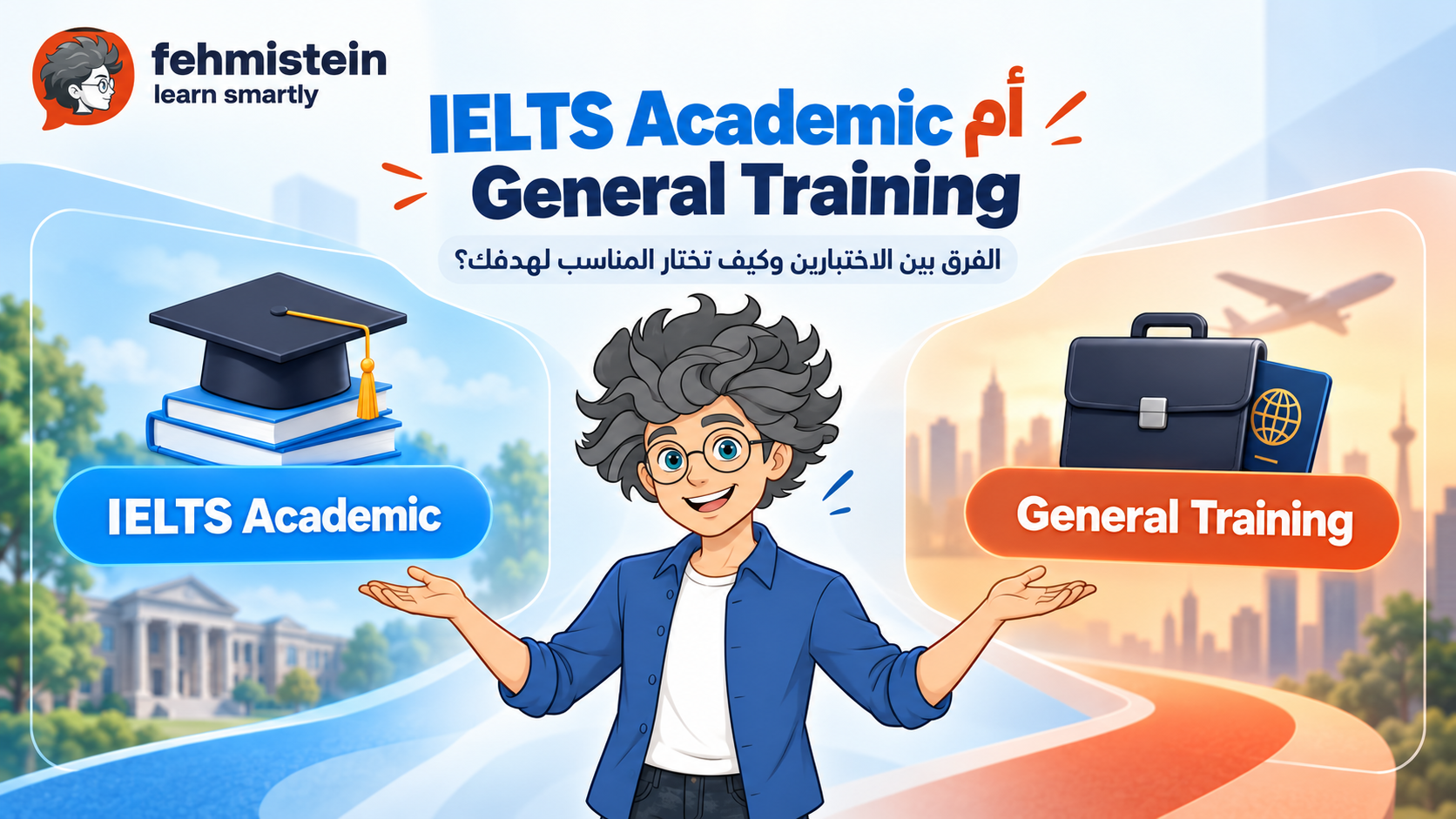
IELTS Academic or General Training?
If you are planning to study, work, or immigrate abroad, you may be wondering: Should I choose IELTS Academic or IELTS General Training?
The short answer is:
- Choose IELTS Academic if your goal is undergraduate or postgraduate study, or professional registration in a field such as medicine or nursing.
- Choose IELTS General Training if your goal is immigration, gaining work experience, enrolling in a training program, or studying below the undergraduate level.
Before booking your test, check the requirements of your university, immigration authority, or professional body. The receiving institution is the one that determines the test type and the required score.
The two tests are identical in the Listening and Speaking sections, but differ in Reading and Writing to align with the purpose of each test, according to the official explanation of IELTS test types.
What Is the Difference Between IELTS Academic and General Training?
The difference between IELTS Academic and General Training lies in the context in which English-language skills are assessed.
- IELTS Academic measures your ability to use English in academic and professional environments. It includes texts more closely related to university study, data analysis, and understanding complex arguments and ideas.
- IELTS General Training measures your ability to use English in everyday life, work, training, and immigration contexts. Its texts and writing tasks focus on practical communication.
Quick Comparison Between the Two IELTS Test Types
- Main purpose:
- Academic: University study, postgraduate study, and professional registration.
- General Training: Immigration, work, training, and study below the undergraduate level.
- Listening: Identical in both tests.
- Speaking: Identical in both tests.
- Reading:
- Academic: Longer academic and analytical texts.
- General Training: Everyday, workplace, and general texts.
- Writing – Task 1:
- Academic: Describe a graph, table, chart, diagram, or process.
- General Training: Write a personal, semi-formal, or formal letter.
- Writing – Task 2:
- Academic: Essay discussing an opinion, problem, or argument.
- General Training: Essay on a general or social topic.
- Scoring scale: 0 to 9 in both tests.
- Most suitable for:
- Academic: University applicants and professional registrants.
- General Training: Immigration, training, and work applicants.
What Is IELTS Academic?
IELTS Academic is primarily designed for applicants to higher education or registration with certain professional bodies.
According to the official IELTS Academic page, this test is suitable for those who want to:
- Study for a bachelor’s, master’s, or PhD degree in English.
- Apply to a university or higher-education institution.
- Register professionally in fields that require proof of an academic level of English, such as medicine and nursing in some countries.
- Demonstrate the ability to handle academic texts, arguments, and data.
However, choosing Academic does not mean that all universities require the same score. A university may require a specific overall score, along with minimum scores in Reading, Writing, Listening, or Speaking.
To learn how to convert your university requirements into a clear preparation plan, read our article: How to Convert Your University or Scholarship Requirements into a Clear Preparation Plan for SAT, TOEFL, or IELTS.
What Is IELTS General Training?
IELTS General Training focuses on English used in everyday social and workplace situations. According to the official IELTS General Training page, this test type is usually suitable for those who want to:
- Immigrate to an English-speaking country.
- Gain work experience or enroll in a training program.
- Study at a school or college below the undergraduate level.
- Demonstrate their ability to communicate in English in daily life and work.
However, do not assume that General Training is automatically accepted for all immigration applications. You must check the official website of the immigration authority and confirm the required IELTS type, the accepted version, and the minimum scores.
Which Sections Are the Same in Academic and General Training?
Both tests consist of four sections: Listening, Reading, Writing, and Speaking.
Listening and Speaking are identical in both test types, while Reading and Writing differ. The basic timings are as follows:
- Listening: Approximately 30 minutes.
- Reading: 60 minutes.
- Writing: 60 minutes.
- Speaking: 11 to 14 minutes.
Listening Section
The Listening test includes 40 questions across four parts. Candidates listen to conversations and social and educational situations, then answer various question types.
The content and assessment method are the same in Academic and General Training, so you do not need a different Listening preparation plan based on your test type.
Speaking Section
Speaking is a face-to-face, recorded interview with a certified examiner. It consists of three parts:
- Introductory questions on familiar topics.
- Speaking about a specific topic using a task card.
- A broader discussion related to Part 2.
The content and assessment criteria are identical in both test types. Details can be reviewed in the official IELTS Speaking guide.
Differences in the Reading Section
IELTS Academic Reading
The Academic Reading test includes three sections and 40 questions to be completed in 60 minutes. Texts are selected from books, journals, magazines, newspapers, and electronic sources. They are written for a non-specialist audience but are appropriate for a university study environment.
Texts may include:
- Detailed logical arguments.
- Scientific or social topics.
- Diagrams or illustrative charts.
- More complex academic vocabulary.
The official IELTS Academic Reading format indicates that the three texts total approximately 2,150 to 2,750 words.
IELTS General Training Reading
This section also includes 40 questions and three parts within 60 minutes, but the nature of the texts is different:
- Part 1: Advertisements, notices, timetables, and everyday life texts.
- Part 2: Work-related texts, such as job descriptions, contracts, and training materials.
- Part 3: A longer text on a general topic.
Details can be found in the official IELTS General Training Reading format.
Is General Training Reading Easier Than Academic?
Academic texts are usually more complex in terms of vocabulary and style. However, this does not always mean that achieving the required score in General Training is easier.
Both tests are assessed on the same 0–9 band scale, but the number of correct answers needed to achieve a particular band in Reading may differ.
The official IELTS Band Score Guide explains that a higher number of correct answers is usually required in General Training Reading to achieve the same band.
For example, official indicative averages suggest that Band 7 may require around 30 correct answers out of 40 in Academic Reading, compared to around 35 correct answers out of 40 in General Training Reading. These figures are approximate and the conversion may vary slightly between test versions.
Differences in the Writing Section
Both test types include two Writing tasks to be completed in 60 minutes:
- Task 1: At least 150 words; suggested time 20 minutes.
- Task 2: At least 250 words; suggested time 40 minutes.
Task 2 carries twice the weight of Task 1 in the calculation of the Writing score.
IELTS Academic Writing
- Task 1: Candidates are asked to describe visual information, such as a graph, table, chart, diagram, stages of a process, or the functioning of a device or system.
- The goal is not to list every number or detail, but to provide a clear overview, select important information, and make appropriate comparisons.
- Task 2: Candidates write an essay discussing an opinion, argument, or problem.
- The official IELTS Academic Writing page explains that assessment is based on task achievement, coherence and cohesion, lexical resource, and grammatical range and accuracy.
IELTS General Training Writing
- Task 1: Candidates write a letter of at least 150 words in response to a given situation. The letter may be personal, semi-formal, or formal. Tasks may involve providing or requesting information, explaining a problem, writing a complaint, or communicating with a manager or service provider.
- Task 2: Candidates write an essay on an opinion, problem, or general topic. The basic assessment criteria remain similar to those of Academic, according to the IELTS General Training Writing details.
Is the Scoring System Different Between the Two Tests?
No. Both tests use the same IELTS 0–9 band scale. You receive a band score for Listening, Reading, Writing, and Speaking, as well as an Overall Band Score.
The Overall Band Score is calculated as the average of the four section scores, then rounded according to IELTS rules to the nearest half or whole band.
However, the required score is not determined by IELTS itself. It is set by the university, immigration authority, or professional body. An institution may require an overall score as well as minimum scores in each skill.
How to Choose the Right Test for Your Goal
Use the following rule:
- Choose IELTS Academic if your goal is:
- Admission to a bachelor’s or postgraduate program.
- University study in English.
- Professional licensing or registration that requires Academic.
- Application to an institution that explicitly states it accepts IELTS Academic.
- Choose IELTS General Training if your goal is:
- Immigration, when the official authority requires General Training.
- Training or gaining work experience.
- Study below the undergraduate level.
- Application to an institution that explicitly states it accepts IELTS General Training.
Do Not Book Before Answering These Questions
- What is the full name of the required test on the institution’s official website?
- Is Academic or General Training required?
- Is IELTS for UKVI required?
- What overall score is required?
- Is there a minimum score for each skill?
- Is the test delivery method available in your country accepted?
- What is the latest acceptable result issue date?
If you are still comparing universities and exams, our article may be helpful: Choosing the University or Starting Test Preparation First? The Correct Academic Sequence for Studying Abroad.
What About IELTS for UKVI?
IELTS for UKVI is not synonymous with General Training. Depending on the visa type, the required test for UK purposes may be:
- IELTS Academic for UKVI.
- IELTS General Training for UKVI.
- IELTS Life Skills.
Therefore, you must review the specific visa requirements, not just rely on the phrase “IELTS test for immigration.” The official guide to IELTS test types explains that the test type depends on the location and the specific purpose of study, work, or residence.
Important Update on IELTS in 2026
On 5 March 2026, IELTS partners announced that the traditional paper-based test will be gradually phased out from mid-2026 in favor of computer-delivered tests, with implementation timing varying by market.
In some markets, a Writing on Paper option will be available, allowing candidates to handwrite the Writing section while completing the rest of the test on a computer. This does not change the skills measured or how scores are interpreted.
Therefore, check the actual options at your test center before booking, as implementation dates differ by country. The full announcement can be read in the official IELTS 2026 update.
Common Mistakes When Choosing an IELTS Test Type
- Choosing General Training because it seems easier: The correct criterion is whether the institution accepts the result. A high score in an unaccepted test will not benefit your application.
- Relying on a friend’s experience: Requirements may differ by country, university, major, visa type, and even application date.
- Confusing test type with test delivery method: Academic and General Training are two different test types with different purposes and content. Computer-delivered tests or the Writing on Paper option are delivery methods, not separate test types.
- Practicing with materials from the wrong test type: Listening and Speaking are shared, but Reading and Writing differ. Most of your practice in these two sections should match the test type you have booked.
How to Prepare After Choosing Your IELTS Test Type
Begin with a placement test or a full practice test, then analyze your performance in each skill instead of focusing only on the overall score.
An effective preparation plan includes:
- Familiarizing yourself with question formats and instructions.
- Practicing within official time limits.
- Building vocabulary related to your test type.
- Analyzing and classifying mistakes.
- Obtaining clear feedback on Writing and Speaking.
- Taking regular mock tests.
- Practicing on a computer if your test will be computer-delivered.
On the Fehmistein platform, training can be organized according to the student’s level and goals, focusing on the skills that need improvement and tracking progress instead of completing random practice that does not reveal the cause of mistakes.
You can begin with the mock tests on the platform to measure your current level. You may also read our article: How to Improve Your IELTS Score Through Smart Training and Error Analysis.
Frequently Asked Questions
Which is better: IELTS Academic or General Training?
There is no universally “better” type. Academic is more suitable for university study and professional registration, while General Training is suitable for immigration, work, and training when accepted by the relevant authority.
Are Listening and Speaking identical in both tests?
Yes. The content and assessment method for Listening and Speaking are identical in Academic and General Training. The main differences are in Reading and Writing.
Can IELTS General Training be used for university admission?
Most undergraduate and postgraduate programs require IELTS Academic. Limited exceptions may exist, but you should rely on the university’s official requirements.
Is IELTS Academic accepted for immigration?
This depends on the country and immigration pathway. Some authorities may accept Academic, while others or specific programs may require General Training. Check the official website of the immigration program before booking.
Is Writing Task 2 the same in both tests?
The general format and assessment criteria are similar, but the topic context and presentation may differ. Task 1 is clearly different: describing data or a diagram in Academic, and writing a letter in General Training.
Does a Band 6.5 in Academic equal a Band 6.5 in General Training?
Both use the IELTS 0–9 band scale, but the receiving institution determines which test type is accepted. The approximate conversion from the number of correct answers to a band score in Reading also differs.
How long is an IELTS result valid?
IELTS partners recommend considering the result valid for two years from the test date, although some institutions may accept older results. Confirm with the institution to which you are submitting the score via the IELTS Score Validity Guide.
Has the paper-based IELTS test been discontinued?
From mid-2026, the paper-based test is being gradually phased out in favor of computer-delivered tests, with a Writing on Paper option available in some markets. Check with your local test center before booking.
Conclusion
The difference between IELTS Academic and General Training is not limited to the difficulty level of the questions. It is linked to the purpose for which each test was designed.
- Choose Academic for university education or professional registration when required by the institution.
- Choose General Training for immigration, work, or training when specified by the official requirements.
The most important rule is: Do not choose the test type based on the impression that it is easier. Choose the test that is accepted by the institution that will use your result, then prepare for it with a plan that matches its content and criteria.
For a free educational and guidance consultation about choosing the right test or applying to international universities, contact the EZ Academy team via WhatsApp:
Phone: +90 552 574 12 76
Direct link: https://wa.me/905525741276
To prepare for IELTS in both test types, explore the smart training tracks on the Fehmistein platform, including organized practice, mock tests, error review, and performance analysis.
A free trial is available for each track via: https://www.ezacademy.com.tr/packages
Similar Articles