How Is the IELTS Score Calculated? Understanding Skill Scores and the Overall Band Score with Examples
Discover How IELTS Scores Are Calculated in Listening, Reading, Writing, and Speaking, Overall Band Rounding Rules, with Clear Numerical Examples and a Training Plan via Fehmistein
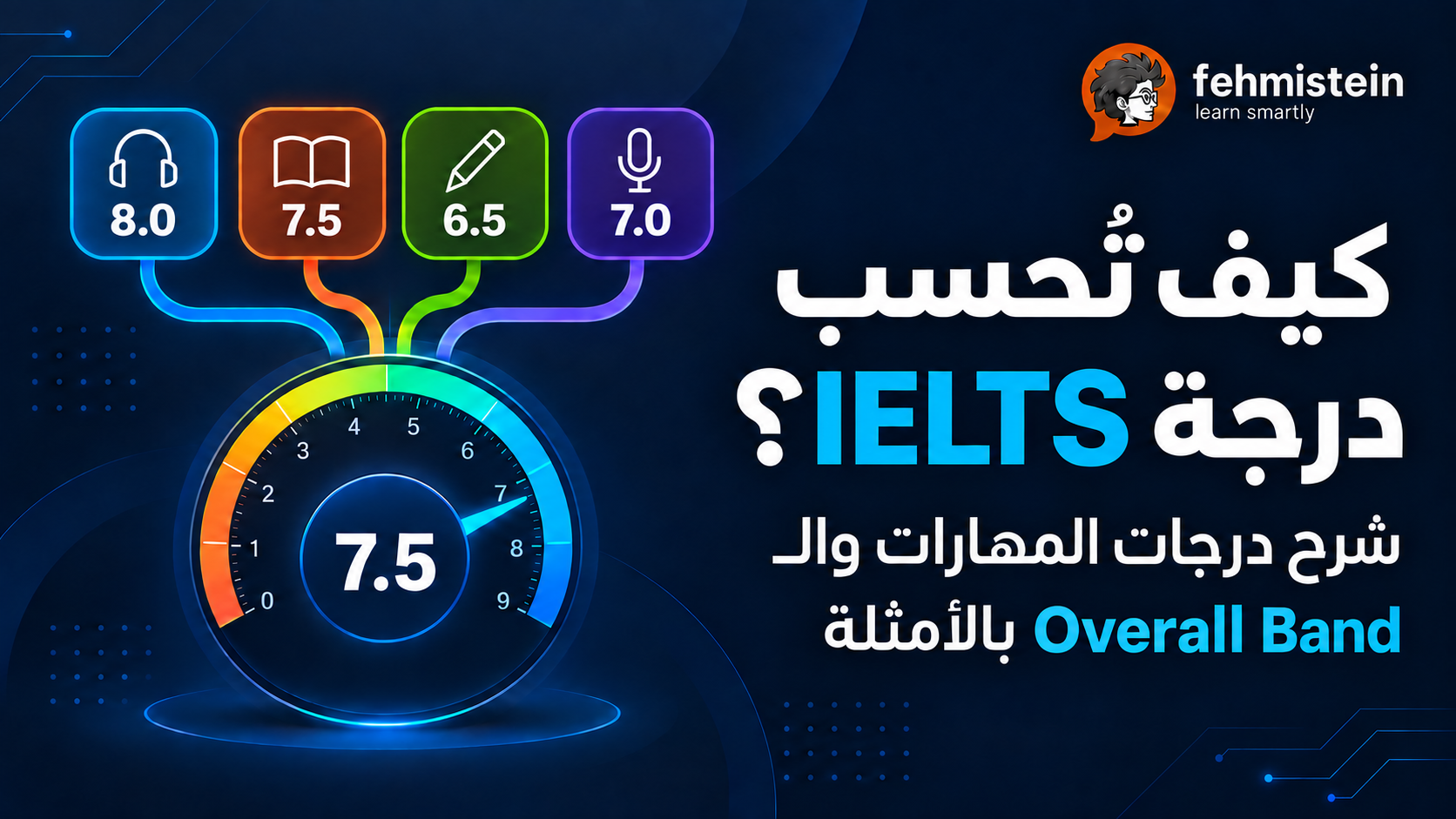
IELTS scores are calculated in two stages: first, the test-taker receives an independent band score from 0 to 9 in each skill — Listening, Reading, Writing, and Speaking — then the four scores are added together and divided by four to calculate the Overall Band Score. After that, the average is rounded to the nearest whole or half band according to official IELTS rules.
However, the method of reaching each skill score is not the same: Listening and Reading depend on the number of correct answers, while certified examiners assess Writing and Speaking according to specific criteria.
How Is IELTS Score Calculated in Brief?
The IELTS report shows five scores: Listening Band Score, Reading Band Score, Writing Band Score, Speaking Band Score, and Overall Band Score.
Each score is between 0 and 9, and may appear as a whole band such as 7.0 or a half band such as 6.5.
The overall score is calculated using the following formula:
Overall Band = (Sum of the four skill scores) ÷ 4
Quick example: If a student gets Listening: 7.5, Reading: 7.0, Writing: 6.5, Speaking: 7.0, the calculation is: 7.5 + 7.0 + 6.5 + 7.0 = 28, then 28 ÷ 4 = 7.0. So the overall score is Overall Band Score: 7.0.
The official IELTS score explanation page confirms that the Overall Band is the average of the four section scores after rounding to the nearest half band.
Is There a Pass/Fail Score in IELTS?
IELTS presents the test-taker’s level on a scale from 0 to 9, but the required score depends on the institution that will use the result.
For example, a university may require: Overall Band not less than 6.5, and no skill below 6.0. Another university or professional body may require: Overall Band equal to 7.0, Writing not less than 7.0, and the rest of the skills not less than 6.5.
Therefore, it is not enough to know your overall score only. You must compare each sub-score with the requirements of the university, immigration authority, or professional body you are applying to.
If you are still determining the right test type for your goal, review our article: IELTS Academic or General Training? The Difference and How to Choose.
How Is IELTS Listening Score Calculated?
The Listening section consists of 40 questions. You get one mark for each correct answer, then the score out of 40 is converted to an IELTS band from 0 to 9.
According to the official indicative table: getting 16 correct answers out of 40 is approximately Band 5.0, 23 answers equal Band 6.0, 30 answers equal Band 7.0, and 35 answers equal Band 8.0.
These numbers are not fixed boundaries for all test forms. IELTS clarifies that the number of answers required to achieve a certain band may vary slightly between one form and another to maintain fairness in difficulty level.
Therefore, it can be said that getting 30 correct answers equals on average Band 7 in Listening, but this is not a guaranteed conversion table for every test.
Example of Listening score calculation: If you answer 30 questions correctly out of 40, your score is expected to be close to Listening Band 7.0. If you answer 35 questions correctly, the indicative score is Listening Band 8.0.
Are Marks Deducted for Wrong Answers?
There are no negative marks for wrong answers. You get a mark for a correct answer, while you get no mark for a wrong or blank answer.
However, you may lose the mark despite understanding the answer due to: spelling errors, writing singular instead of plural or vice versa, exceeding the word limit, writing the answer in the wrong field, or not following the question instructions.
Therefore, your training should include accuracy in entering the answer, not listening skill alone.
How Is IELTS Reading Score Calculated?
The Reading section also contains 40 questions, and you get one mark for each correct answer. Then the raw score is converted to a Band Score from 0 to 9.
However, score conversion differs between IELTS Academic Reading and IELTS General Training Reading. The reason is that Academic texts may include more complex vocabulary and structure, while a General Training test-taker usually needs more correct answers to get the same band.
Academic Reading Score Table (Indicative):
- 15 correct answers ≈ Band 5.0
- 23 answers ≈ Band 6.0
- 30 answers ≈ Band 7.0
- 35 answers ≈ Band 8.0
General Training Reading Score Table (Indicative):
- 15 correct answers ≈ Band 4.0
- 23 answers ≈ Band 5.0
- 30 answers ≈ Band 6.0
- 35 answers ≈ Band 7.0
Example illustrating the difference: If two students answer 30 questions correctly, an Academic Reading test-taker gets on average Band 7.0, while a General Training Reading test-taker gets on average Band 6.0 only. This does not mean one test is better than the other; rather, the nature of the texts and their complexity level are different, so the conversion of correct answers differs.
Official IELTS score calculation rules state that Listening and Reading tables are indicative, and the exact boundary may vary slightly from one form to another.
Is There a Full Official Table Converting Every Score out of 40?
IELTS publishes indicative points for several bands, but it warns against treating them as fixed boundaries for every form.
Therefore, you may find on some websites tables starting from 0 to 40 specifying every half band, but these tables are mostly estimates and not an official guarantee. It is better to use them to measure your progress approximately, allowing a small margin of difference.
If your goal is Band 7, for example, do not make your training goal exactly the expected minimum. Try to maintain a slightly higher number of correct answers so you are not affected by differences in form difficulty or test-day errors.
How Is IELTS Writing Score Calculated?
The Writing score does not depend on a specific number of correct answers; instead, a certified IELTS examiner assesses your performance in both tasks according to four criteria:
- Task Achievement (Task 1) or Task Response (Task 2): How well you answer all parts of the task and develop ideas appropriately.
- Coherence and Cohesion: Organization of ideas and paragraphs, information flow, and use of linking devices.
- Lexical Resource: Range, accuracy, and appropriateness of vocabulary.
- Grammatical Range and Accuracy: Variety of grammatical structures and accuracy of use.
The official IELTS Writing format page clarifies that each task is assessed independently, and the four criteria within a single task carry equal weight.
Is Task 2 More Important Than Task 1?
Yes. Writing Task 2 carries more weight than Task 1 in calculating the final Writing score. Therefore, it is usually recommended to allocate about 20 minutes for Task 1 and 40 minutes for Task 2.
This does not mean neglecting Task 1, because not completing it lowers the Writing score. But it means that weakness in Task 2 affects the final score to a greater extent.
How Is the Score for a Single Task Calculated?
The examiner looks at the four criteria together. For example, an imaginary Task 2 response might be assessed as: Task Response 7.0, Coherence and Cohesion 6.0, Lexical Resource 6.5, Grammatical Range and Accuracy 6.5.
These assessments are used according to the IELTS system to reach the task score, then both tasks’ results are included in the Writing Band calculation, with Task 2 given more weight.
The example helps you understand the criteria, but it is not an official calculator for your score; because the final assessment is subject to IELTS’s approved correction and standardization procedures.
Why Might Writing Score Remain Low Despite Using Advanced Words?
The writing score is not calculated by the number of difficult words. A student may use advanced vocabulary but get a lower score due to: not answering all parts of the question, weak idea development, lack of logical flow between paragraphs, using advanced words in incorrect context, repeating grammatical errors, writing below the minimum word count, or memorizing a template that does not fit the question topic.
Therefore, all four criteria should be improved together instead of focusing on vocabulary alone. You can review official IELTS Writing criteria and performance level descriptors to understand the differences between bands.
How Is IELTS Speaking Score Calculated?
A certified examiner assesses your performance in the Speaking test according to four equally weighted criteria:
- Fluency and Coherence
- Lexical Resource
- Grammatical Range and Accuracy
- Pronunciation
The official IELTS score calculation guide confirms that the four criteria carry equal weight in speaking assessment.
Illustrative example: If hypothetical performance ratings are Fluency and Coherence 7.0, Lexical Resource 6.5, Grammatical Range and Accuracy 6.0, Pronunciation 6.5, the examiner will consider your performance across the four criteria to reach the final Speaking Band according to IELTS’s approved procedures.
Does Accent Affect Speaking Score?
You are not required to speak with a British or American accent. What is required is that your pronunciation is clear and understandable.
You do not lose score just because your native accent appears, but Pronunciation score may decrease if your way of producing sounds, stress, or rhythm makes your speech difficult to understand.
Does Pausing During Speech Lower the Score?
Natural pausing for thinking does not automatically lower the score. But frequent hesitation, repetition of words, and long pauses to search for vocabulary may affect the Fluency criterion.
Also, speaking too fast is not evidence of fluency if ideas become unclear or errors increase.
How Is Overall Band Calculated in IELTS?
After determining the four skill scores, they are added and divided by four:
Overall Band = (Listening + Reading + Writing + Speaking) ÷ 4
Then the result is rounded to the nearest half band.
Official rounding rules:
- If the average ends in 0.25, it is rounded up to the next half band.
- If the average ends in 0.75, it is rounded up to the next whole band.
- Other values are rounded to the nearest whole or half band.
Examples of Overall Band Calculation
Example 1 (Average equals a whole band):
Listening 7.5, Reading 7.0, Writing 6.5, Speaking 7.0 → Sum 28 ÷ 4 = 7.0 → Overall Band = 7.0.
Example 2 (Average ends in 0.25):
Listening 6.5, Reading 6.5, Writing 5.0, Speaking 7.0 → Sum 25 ÷ 4 = 6.25 → rounded up to the next half → Overall Band = 6.5. (Example from official IELTS explanation)
Example 3 (Average ends in 0.75):
Listening 7.0, Reading 7.0, Writing 6.5, Speaking 6.5 → Sum 27 ÷ 4 = 6.75 → rounded up to the next whole band → Overall Band = 7.0.
Example 4 (Average 6.125):
Listening 6.5, Reading 6.5, Writing 5.5, Speaking 6.0 → Sum 24.5 ÷ 4 = 6.125 → rounded to nearest half → Overall Band = 6.0. (From examples published in official IELTS explanation)
Example 5 (Average 6.375):
Listening 7.0, Reading 6.5, Writing 6.0, Speaking 6.0 → Sum 25.5 ÷ 4 = 6.375 → nearest is 6.5 → Overall Band = 6.5.
Does 6.25 Appear in the IELTS Report?
No. 6.25 does not appear as a final Overall Band. After rounding it becomes 6.5. Similarly: 6.75 becomes 7.0, 7.25 becomes 7.5, and 7.75 becomes 8.0.
Section scores appearing in the report are displayed in whole or half bands, such as 6.0, 6.5, 7.0.
Can a Strong Skill Compensate for a Weak One?
Yes, mathematically; because the overall score is the average of the four sections. A score of 8.0 in Listening can raise the average if Writing is 6.0.
But this compensation may not help you in admission if the institution requires a minimum score for each skill.
Example: Student results: Listening 8.0, Reading 7.5, Writing 5.5, Speaking 7.0. Calculation: 8.0 + 7.5 + 5.5 + 7.0 = 28 ÷ 4 = 7.0. The student gets Overall 7.0, but their application may be rejected if the university requires Writing not less than 6.0 or 6.5.
Therefore, you must track two different numbers: the required overall score, and the required minimum in each skill.
What Do IELTS Scores from 0 to 9 Mean?
According to the official brief description for each band:
- 9: Expert user
- 8: Very good user
- 7: Good user
- 6: Competent user
- 5: Modest user
- 4: Limited user
- 3: Extremely limited user
- 2: Intermittent user
- 1: Non-user
- 0: Did not attempt the test
Band 7 does not mean the test-taker makes no mistakes. According to IELTS description, a person at this level can handle complex language and understand detailed reasoning generally, despite the possibility of some errors or misunderstandings.
Does Score Calculation Differ Between IELTS Academic and General Training?
The basic rules remain the same: four skills, a score from 0 to 9 for each skill, average of the four scores to calculate Overall Band, same criteria in Listening and Speaking, and a compatible assessment system in Writing.
But the clearest difference in calculation appears in Reading; a General Training test-taker usually needs more correct answers to get a band equivalent to an Academic Reading score.
Also, Writing Task 1 tasks differ: in Academic, the test-taker describes a graph, table, chart, or process, while in General Training, they write a letter according to a specific situation. Task 2 requires writing an essay in both tests, with differences related to context and task nature.
To delve deeper into the differences between the two types, review our dedicated article: IELTS Academic or General Training? The Difference and How to Choose the Most Suitable.
Do Scores Differ Between Computer-Delivered and Paper-based IELTS?
No. The test delivery method does not change the score scale or assessment criteria.
In computer-delivered IELTS: you enter Listening and Reading answers on screen, write the Writing section using the keyboard, and Speaking is assessed according to the same criteria.
IELTS confirmed when updating the test delivery method in 2026 that the transition to computer does not change the skills measured, assessment structure, or interpretation of results. The official announcement about IELTS delivery update can be reviewed.
How Does One Skill Retake Affect the Overall Score?
If you are eligible for IELTS One Skill Retake, you can retake one skill. A new report is issued containing: the new score for the retaken skill, the original scores for the other three skills, and an updated Overall Band according to the new average.
Example: Original results: Listening 7.5, Reading 7.0, Writing 6.0, Speaking 7.0. Sum 27.5 ÷ 4 = 6.875, after rounding Overall Band = 7.0. If the student retakes Writing and raises it to 6.5, the average becomes 28 ÷ 4 = 7.0. The overall score remains 7.0, but the student has raised Writing from 6.0 to 6.5, which may help them meet the minimum skill requirement.
Therefore, the benefit of retaking a skill should not be measured by change in Overall only. You can review official IELTS One Skill Retake conditions, and confirm that the institution you will apply to accepts the updated result.
How Do You Know the Score You Need in the Next Attempt?
Start from the institution’s requirements, then calculate the gap between your current result and the goal.
If the university requires Overall 7.0 and no skill below 6.5, and your scores are Listening 7.0, Reading 6.5, Writing 6.0, Speaking 6.5, the main problem is not the average alone, but Writing. You need to raise Writing to at least 6.5 to meet the skill requirement, then recalculate the average.
If your four scores are between 5.5 and 6.0 and the goal is 7.0, the priority is not collecting a few points in one section, but developing the general level and test strategy across all skills.
How Do You Use Your Understanding of the Scoring System in Preparation?
- Set a numerical goal for each skill. Do not be satisfied with “I want Band 7.” Specify, for example: Listening 7.5, Reading 7.0, Writing 6.5, Speaking 7.0. This helps you know where you need a safety margin and where you should focus your time.
- Track the number of correct answers in Listening and Reading. Record your raw score out of 40 in each practice test, then compare it with official indicative points. Do not rely on one attempt; calculate your average performance across several models.
- Assess Writing according to the four criteria. The phrase “the essay is good” is not a measurable assessment. Review separately: task achievement, organization of ideas, vocabulary, and grammar.
- Analyze Speaking instead of just talking. Record your answers, then monitor: pause duration, word repetition, pronunciation clarity, sentence variety, vocabulary accuracy, and the ability of the response to develop naturally.
- Take full mock tests. Your score when solving a single section may differ from your performance after two hours of concentration. Therefore, you need a full simulation that reveals the effect of time, fatigue, and transition between skills. You can start with a simulated diagnostic test for IELTS on Fehmistein platform.
How Does Fehmistein Help You Track IELTS Scores?
Fehmistein allows you to practice IELTS tracks in an organized way through: placement tests, skill- and question-type-based drills, difficulty level selection, mock tests, solution review, error and performance analysis, focus on weaknesses, and tracking level development instead of relying on general impression.
In Listening and Reading, track the number of correct answers and types of repeated errors. In Writing and Speaking, link your training to official assessment criteria, then adjust your plan according to the skill preventing you from achieving the required score.
Start your training with a free trial on Fehmistein.
Frequently Asked Questions About IELTS Score Calculation
How do I calculate my overall IELTS score?
Add Listening, Reading, Writing, and Speaking scores, then divide the sum by four. The result is rounded to the nearest whole or half band.
Does 6.25 become 6 or 6.5?
6.25 is rounded to 6.5 according to official IELTS rules.
Does 6.75 become 7?
Yes. Average 6.75 is rounded to Overall Band 7.0.
Does 6.125 become 6 or 6.5?
It is rounded to the nearest half band, so it becomes 6.0.
How many correct answers do I need to get Band 7 in Listening?
Official figures indicate an average of about 30 correct answers out of 40. The boundary may vary slightly from one form to another.
How many correct answers do I need to get Band 7 in Academic Reading?
The official indicative average is about 30 correct answers out of 40.
How many correct answers do I need to get Band 7 in General Training Reading?
The indicative average is about 35 correct answers out of 40.
Does every question in Listening and Reading have the same score?
Yes. The test-taker gets one mark for each correct answer, then the total out of 40 is converted to a Band Score.
Is Task 2 more important than Task 1 in Writing?
Yes. Task 2 carries more weight in calculating the Writing score, so it usually needs more time. But both tasks must be completed.
What are the Speaking assessment criteria?
Fluency and coherence, vocabulary, grammatical range and accuracy, and pronunciation. The four criteria carry equal weight.
Does accent lower Speaking score?
Having an accent does not automatically lower the score. What matters is that pronunciation is clear and understandable and that speech does not hinder communication.
Can a high Listening score compensate for low Writing?
It may raise the overall score mathematically, but it does not compensate for a minimum Writing requirement if the university or institution imposes it.
Does correction method differ in computer-delivered IELTS?
No. Assessment criteria and score scale remain the same, whether the test is delivered on computer or another approved format.
How long is IELTS score valid?
IELTS recommends considering the result valid for two years from the test date, but some institutions may adopt a different policy; therefore, you must confirm directly with them.
Conclusion
IELTS score is calculated differently by skill: Listening and Reading depend on the number of correct answers out of 40, then the number is converted to a Band Score. Writing depends on four criteria, with more weight for Task 2. Speaking depends on four equally weighted criteria.
The overall score is calculated by adding the four skill scores and dividing by four, then rounding the average to the nearest half band.
Understanding the scoring system helps you set a realistic goal for each skill, but it does not replace reviewing the requirements of the institution you will apply to. You may achieve the required Overall Band, yet still need to raise one section due to a minimum skill requirement.
For a free educational consultation about IELTS test or choosing the most suitable path for your goal, contact the EZ Academy team via WhatsApp:
Phone: +90 552 574 12 76
Direct link: https://wa.me/905525741276
Prepared by: The Educational Content Team
Consultancy Review: Ms. Inaya Zureik, Founder and Director of EZ Academy and Fehmistein
Last updated: September 2026