أفضل خطة يومية لتعلم اللغة الإنجليزية في المنزل (30 دقيقة فقط يومياً)

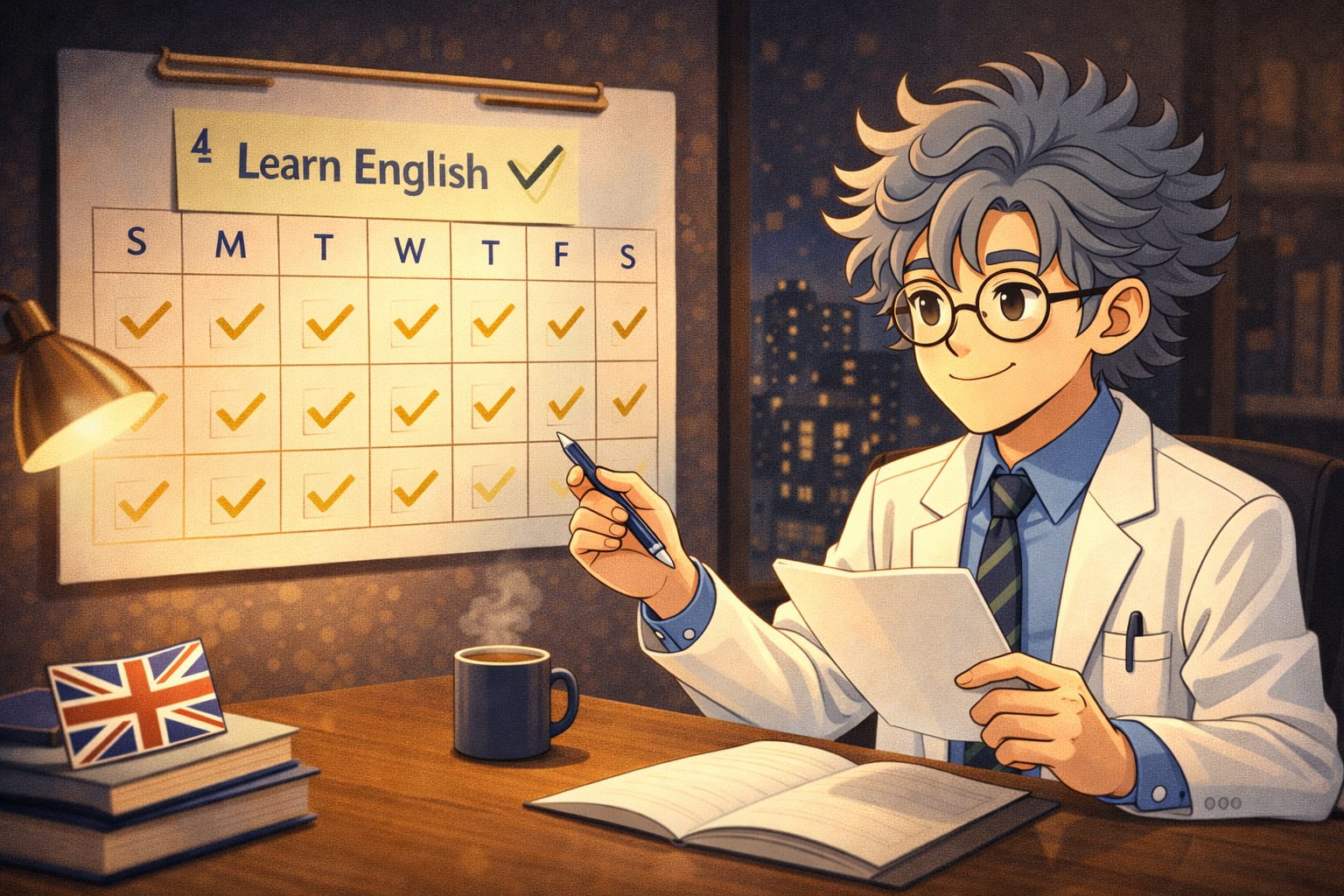
The Best Daily Plan to Learn English at Home (Just 30 Minutes a Day)


Introduction: Do You Really Not Have Time to Learn English?

Many people repeat the same sentence when the topic of learning English comes up: "I don't have time." But if you look at your day honestly, you'll find hours disappearing into your phone, more time spent scrolling through social media, and long stretches passing without making any real difference in your life or career.

The real question, then, is not about time — it's about having a plan. You don't need long hours sitting in front of books to learn English. You only need 30 organized, well-structured minutes every single day.

One student started this simple routine with no prior background in the language, and after just one month he was understanding English content more clearly, forming complete sentences, and had regained his confidence when speaking in front of others. That story is not an exception — it is the natural result for anyone who follows the right plan consistently.

If you're looking for a practical way to learn English for beginners without pressure or complexity, this article gives you a proven daily plan to help you improve your English language skills from home, without needing a tutor, a language school, or a large budget.

Why Is English a Necessity and Not a Luxury?

Before we dive into the plan, it's important to understand why millions of people around the world are working to learn English at home and beyond. English today is the language of business, commerce, science, and technology. Most of the useful digital content on the internet is written or recorded in English. Good job opportunities at most companies require fluency or at least a working understanding of it. And even in your daily life, you'll find that the ability to communicate in English opens doors that were previously closed.

Improving your English language skills is no longer an optional extra — it has become a core part of the personal and professional growth of anyone who wants to compete in the modern job market or connect with the world around them.

Why Do Most Attempts to Learn English Fail?

Before we talk about the solution, it's important to understand the most common reasons for failure, because avoiding mistakes is half the journey to success.

Overwhelming and discouraging plans: When a plan is exhausting and packed with details and terminology, the learner feels its weight from day one and stops before they truly begin. Many people have bought thick textbooks or enrolled in intensive courses only to abandon them after a few days because the curriculum was simply more than they could handle at that stage.

Unrealistic long sessions: Demanding a one- or two-hour study session every day from the very beginning is not realistic for most people who have jobs, families, and commitments. These ambitious plans are quickly abandoned when they collide with the pressures of daily life.

Theoretical learning without application: Watching educational videos and reading grammar rules without actually practicing the language produces no real progress. Language is a practical skill, much like driving a car — you cannot learn it by watching alone.

The absence of a clear goal: Many learners start by saying "I want to learn English" without specifying exactly what they want. Do they want to speak in a professional setting? Understand films? Travel? Each goal requires a slightly different path.

The right solution to all of these problems rests on three essential pillars: a simple and clear plan, a short session that can be sustained, and consistent daily application.

The Scientific Truth That Changes Everything About Learning English

Many people believe that whoever studies more progresses faster, and while that is partly true, it is not the full picture. Studies in neuroscience and educational psychology confirm that the human brain requires regular, spaced repetition to consolidate new information — not large amounts crammed into a single session.

30 minutes a day over 30 days equals 15 hours of consistent, regular learning. Those fifteen hours, when organized and varied across listening, speaking, reading, and review, are more than enough for you to notice a clear and tangible difference in your level of English.

The Ideal Daily Routine for Learning English in 30 Minutes

Part One: Vocabulary (10 Minutes)

The goal of this section is to build a solid linguistic foundation from the core words you use in your daily life. Learn 10 new words every day, with full focus on using them in real sentences rather than simply memorizing them in isolation.

The difference between a successful learner and others is that the successful one never memorizes a word alone — they memorize it inside a real sentence. For example, a word like "Improve" is not enough on its own. You need to learn how to integrate it into your speech:

I want to improve my English every day.

Practicing speaking will help me improve faster.

I need to improve my vocabulary before the interview.

When you memorize a word this way, recalling it later becomes faster and more natural, because your brain holds it connected to a real meaning rather than an abstract sound.

Part Two: Listening (10 Minutes)

The goal of this section is to develop your listening comprehension skill, which is one of the most neglected skills among learners in the beginning — and one they struggle with most later when speaking with native speakers.

Listen to simple English content appropriate for your current level, then immediately repeat the sentences you hear out loud. This is what linguists call phonetic shadowing, and it is one of the most powerful methods for acquiring the natural tone and rhythm of a language.

A direct practical example: listen to a sentence like "I am learning English every day and I can feel the improvement," then repeat it immediately after hearing it. In the beginning you will make mistakes with some sounds, and that is completely normal. But with continued practice you will find that your tongue naturally begins to adapt to the sounds of the English language.

Part Three: Speaking (5 to 7 Minutes)

The goal here is to build self-confidence when speaking English, and this is the part that most learners fear and continuously postpone. The fear of speaking is the single greatest obstacle to learning English for many people.

During these minutes, talk about your day using the words and sentences you just learned. Do not wait until you have mastered grammar perfectly before you start speaking, because that waiting can stretch on for years. Speak now and correct yourself later.

Simple examples you can start with in your first days:

Today I studied English for 30 minutes.

I learned five new words and I tried to use them.

Tomorrow I will practice speaking again.

Over the weeks, you will notice that your sentences become longer and more natural — and that is exactly what improving your English speaking skills means.

Part Four: Review (3 to 5 Minutes)

The goal of this section is to consolidate everything you have learned in the session and ensure it transfers from short-term memory to long-term memory. Review the words you memorized, read the sentences you wrote, and repeat what you listened to.

You can use a small dedicated notebook for your English learning sessions, writing the new words daily with one sentence for each. After a week, go back and review what you wrote in previous days. This type of spaced review is one of the most scientifically powerful methods for cementing language in long-term memory.

The Full 30-Day Plan: How Do You Progress Week by Week?

Week One — The Habit Phase: In this phase your only goal is to commit to the routine every day without putting pressure on yourself about quality. Build the habit first, and improvement will follow naturally.

Week Two — The Improvement Phase: You will start noticing that you understand English content faster and more clearly than you did just two weeks ago. Words will begin coming to mind more quickly when you need them.

Week Three — The Speaking Phase: You will find yourself using English sentences more naturally and spontaneously, and you may even begin thinking in certain English phrases before translating them from your native language.

Week Four — The Confidence Phase: You will speak with greater confidence, form longer and more complex sentences, and feel the enormous difference compared to your very first day.

After 30 days of genuine commitment to this plan, you will have acquired approximately 300 new English words in real contexts, built a bank of useful everyday sentences, and proven to yourself that you are capable of consistency — which is the greatest victory in any language learning journey.

Practical Daily Exercises to Improve Your English Language Skills

Here are four exercises you can incorporate into your daily routine to accelerate your progress:

Exercise One — Words and Sentences: Choose 5 new words and form a separate, distinct sentence for each one. Try to make the sentences relate to your personal life so they are easier to remember.

Exercise Two — Describe Your Day: At the end of each day, describe what you did in English. This can be through writing, speaking in front of a mirror, or even recording a voice note for yourself.

Exercise Three — The Full Minute: Speak for a full minute without stopping on any topic you choose. Do not stop to correct yourself — just keep talking. This exercise helps you break through the barrier of fear around speaking.

Exercise Four — Listen and Repeat: Listen to a sentence or short paragraph from a reliable source, then repeat it with the same tone, rhythm, and pace. Over time you will notice that your pronunciation improves noticeably.

Common Mistakes That Hold Back Your Progress in Learning English and How to Avoid Them

Learning without a clear plan: Jumping from one app to another and from one resource to another makes you feel like you're learning when in reality you are just scattered. Commit to one plan for 30 days before thinking about changing it.

Stopping and trying to make up for missed days: Many learners stop for a few days then try to compensate with long sessions. This doesn't work. Daily consistency, even if only 20 minutes, is far better than one long session per week.

Memorizing words without context: Vocabulary memorized as bare lists is forgotten very quickly. Always connect every word to a sentence and to a real situation.

Postponing speaking until you "master" the language: This is the most common and most damaging mistake. Speaking is the path to mastering speaking, and there is no other way. Start talking from day one, even if it's just one sentence.

Why Are 30 Minutes a Day Enough to Learn English?

The scientific answer is that the human brain learns through regular repetition, not through large sporadic amounts. Daily consistency, even for a short period, creates new neural pathways in the brain that reinforce the language over time. Quality in a learning session matters far more than its length, and 30 focused, distraction-free minutes surpass two hours of unfocused screen time in terms of real effectiveness.

Frequently Asked Questions About Learning English at Home

Are 30 minutes a day really enough to learn English?

Yes, provided you commit genuinely every day and apply what you learn in practice. Consistency is the key — not the length of the session.

How long do I need before I see tangible results in my English skills?

Most consistent learners notice clear improvement within two to four weeks, particularly in listening comprehension and vocabulary.

Do I need a teacher to learn English at home?

Not necessarily, especially in the early stages. You can make significant progress by following a clear, organized plan using the resources available online. However, a teacher can help accelerate progress and correct errors later on.

What is the best time of day to learn English?

The best time is the time you can commit to every single day. Some people prefer the morning when the mind is fresh, while others find the evening more suitable. What matters most is staying consistent with the same time each day until the routine becomes an automatic habit.

Can I learn English from scratch with this method?

Yes. This plan is specifically designed for beginners learning English from zero, and it progresses with you step by step without overwhelming you with more information than you need at any given stage.

Conclusion: Your Decision Today Determines Your Level Tomorrow

If you want to learn English at home, you do not need a lot of time, special resources, or natural talent. You only need 30 minutes a day, distributed wisely across vocabulary, listening, speaking, and review — along with a genuine decision to keep going.

Every person who speaks English fluently today was once a beginner who didn't know how to form a single sentence. The only difference between them and those who stopped is consistency — nothing more.

Similar Articles
card-img-top
LEARN ENGLISH
How to Learn English from Scratch Step by Step (The Complete Beginner's Guide in 90 Days)
card-img-top
Student Life LEARN ENGLISH
How to Memorize English Vocabulary Quickly Using the Three‑Stage System: The Real Professionals’ Method
card-img-top
LEARN ENGLISH
100 English sentences used daily in conversation with translation and practical examples Translate it into English.