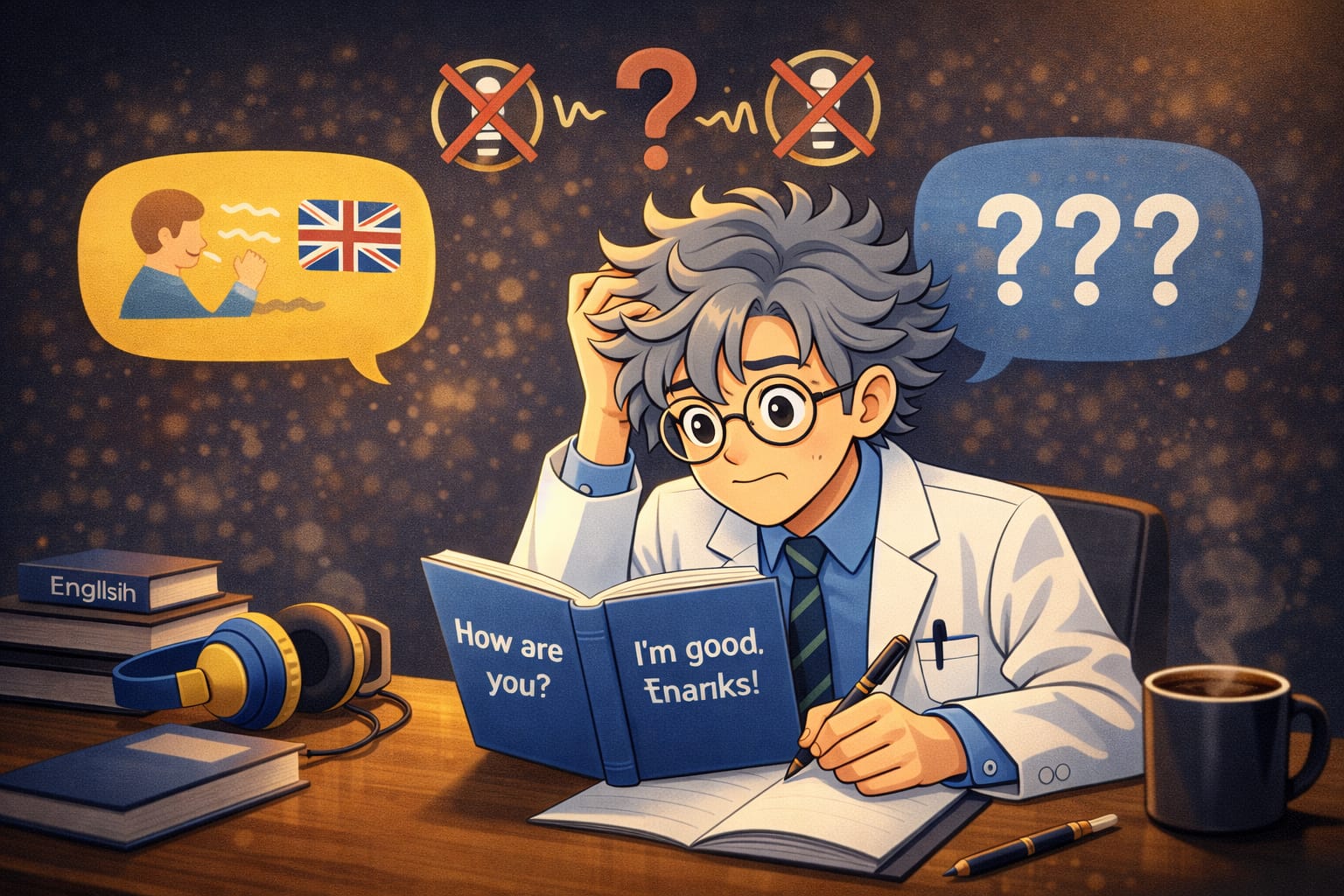
Why do you understand English but can’t speak it? The real reasons and practical solutions.
Introduction
Many English learners fall into the same trap: they watch movies and understand the dialogues, and they read articles without difficulty, but when they try to say even one sentence, the words stop and the mind becomes almost blank.
If you are going through this experience, you are not alone, and this does not mean that you are untalented or that the language is harder than your ability. In most cases, the problem goes back to the learning method, not to your personal abilities.
In this article, we will explain the root causes of this phenomenon, and we will give you a practical plan and daily exercises that will help you actually and noticeably improve your English speaking skills.
The difference between understanding a language and speaking it
Before we discuss the reasons, it is necessary to understand the basic distinction between two types of language skills:
- Receptive skills (Passive Skills): These are listening and reading, and they depend on receiving information and understanding it.
- Productive skills (Active Skills): These are speaking and writing, and they depend on generating language from within and producing it.
Most people who learn English in schools or through apps and video clips focus only on receptive skills. This is what makes them understand the language well but fail to speak when the real moment comes.
Speaking is a separate skill that needs separate training. For more details about the types of language skills and how to develop them, you can check the educational content at:
EZ Academy – English Learning Guide
The real reasons that stop you from speaking English
First reason: Learning without real application
Watching lessons, reading grammar, and listening to conversations are all useful tools, but they remain in the circle of understanding only. If you do not move to the stage of real application and using speaking exercises in English, what you have learned will not turn into a real ability to speak.
Understanding alone is not enough. You must produce the language yourself, even if you are speaking alone at the beginning.
Second reason: Memorizing words instead of sentences
There is a big difference between knowing a word and being able to use it in a real context. Many learners memorize lists of vocabulary but do not practice using them inside full sentences.
For example, you know the word "opportunity" but you hesitate when you want to say: "I missed a great opportunity." The solution is to memorize words inside ready-made sentences and repeat them until they become automatic.
Full sentences are the real unit of learning, not single words.
Third reason: Fear of making mistakes
Many learners delay speaking on the pretext that they have not reached a sufficient level yet. But the truth is that this level will never come unless you start speaking for real.
Mistakes are not a sign of failure; they are an inevitable part of learning any skill. Everyone who speaks English fluently today went through a phase of many mistakes at the beginning.
Fourth reason: Thinking in Arabic and mentally translating
When you try to form an English sentence, do you construct it in Arabic first and then translate it? This habit slows you down a lot and prevents fluency, because the two languages do not match in structure.
The long-term goal is to think directly in English. This does not happen all at once, but it begins when you practice building simple sentences directly without the mediation of translation.
Fifth reason: Neglecting regular speaking practice
Speaking in any language is a mental motor skill, like learning to swim or drive a car. It is not enough to know the rules theoretically; you must practice until the response becomes automatic.
Anyone who does not allocate daily time for speaking practice will not see improvement, no matter how much vocabulary or grammar they learn.
The real solution: How to improve your English speaking skill
Step 1: Learn full sentences instead of single words
Start by learning daily phrases and sentences that can be used immediately, such as:
- I am learning English to improve my future.
- I forget things when I don't practice.
- Can you say that again, please?
These sentences are stored in your memory as ready-made units, which makes them come out automatically when you need them.
To see a list of the most important daily English sentences, you can visit:
Daily Sentences Page on EZ Academy
Step 2: Use what you learn immediately
Do not wait until you learn "more" before you speak. Use every new sentence you learn on the same day, even if that is just speaking out loud by yourself.
Practical example: If you learned today how to describe your day, talk about your actual day:
"Today I woke up at seven. I had breakfast and studied English for twenty minutes."
Step 3: Speak out loud every day
It does not have to be in front of another person at the beginning. You can:
- Speak in front of a mirror and observe your facial expressions and pronunciation.
- Record your voice and listen to it to discover weak points.
- Describe what you are doing or what you see during your day in English.
The important thing is that speaking becomes a daily habit that does not stop.
Step 4: Get over the perfection barrier
Do not wait for your sentence to be perfect before you say it. Say what you can, and accept mistakes as a natural part of the process. Over time, mistakes will decrease automatically as practice continues.
Step 5: Start thinking in English
Set aside small moments during your day to think directly in English. Start with very simple sentences such as: "I am tired." or "The weather is nice today." then move step by step to more complex ideas.
Step 6: Smart repetition
Repeating the same sentence in different contexts is the best way to fix it. Do not be satisfied with reading the sentence once; use it in multiple situations until it becomes part of your real language stock.
Practical exercises to improve speaking skills
Exercise 1: Free speaking for 30 seconds
Choose a simple question and answer it out loud for 30 seconds continuously.
Example: "Why are you learning English?"
Do not stop at mistakes; keep talking until the time ends.
Exercise 2: Describe your day in English
At the end of each day, describe what you did in English. The sentences can be very simple:
"I woke up at eight. I had coffee. I went to work."
The goal is continuity, not perfection.
Exercise 3: Turn words into sentences
Take any new word you learn and immediately turn it into a sentence:
- The word "improve" becomes: I want to improve my speaking skills.
- The word "practice" becomes: I need to practice every day.
Exercise 4: Voice recording and review
Record yourself speaking for one minute about any topic, then listen to the recording. You will notice for yourself where you hesitate and where you mispronounce, and this self-awareness is a strong step toward improvement.
A 7‑day plan to start speaking English
- Day 1: Learn 10 daily sentences and memorize them out loud.
- Day 2: Use each of the ten sentences in a real or imaginary situation.
- Day 3: Record your voice speaking for one minute, then listen to the recording.
- Day 4: Speak in English for a full minute in front of the mirror without stopping.
- Day 5: Describe your entire day in English, from waking up until evening.
- Day 6: Speak without stopping for two minutes about any topic you choose.
- Day 7: Review the sentences you learned during the week and test yourself on your ability to use them.
Common mistakes to avoid
- Waiting for the "right time": There is no perfect time to start. Start now with what you have.
- Studying without application: Reading and watching alone will not make you speak. Real application is the key.
- Relying on translation: Try to gradually reduce mental translation.
- Stopping at the first mistake: Continuing despite mistakes is what builds fluency in the long term.
To learn more about common mistakes in learning English and how to overcome them, you can read the detailed articles at:
How does EZ Academy help you improve your speaking skill?
Instead of random learning that takes a long time without clear results, EZ Academy offers an organized approach that starts by determining your current level, then creating a customized study plan focusing on the skills you really need, with practical exercises that guarantee immediate application of everything you learn.
You can start now by visiting:
Related articles
- Daily exercises to learn English from scratch
- The 100 most common English sentences in daily life
- How to memorize English vocabulary and never forget it
Frequently asked questions
Why do I understand English well but cannot speak it?
Because understanding and speaking are two different skills, and each one needs separate training. Understanding develops from listening and reading, while speaking develops from actual practice of talking.
Can I improve my English speaking skill quickly?
Yes. With regular daily practice, you can notice clear improvement within a few weeks, especially if you follow an organized plan based on full sentences and immediate application.
How much time do I need daily to practice speaking?
10 to 20 minutes a day is enough to start, provided these minutes are real speaking practice, not just watching or reading.
Can I improve without a teacher?
Yes. Speaking in front of a mirror, recording your voice, and describing your day in English are all effective methods you can practice on your own.
Where do I start if I am a complete beginner?
Start by learning simple daily sentences and using them immediately. Do not wait to "learn a lot" before you start speaking.
Conclusion
If you understand English but cannot speak it, know that this problem can be completely solved. The reason is not a lack of talent, but the absence of real training on the speaking skill.
The solution starts with one step: speak. Speak today, speak tomorrow, and keep going. Learn full sentences and use them immediately, and do not wait for perfection, because fluency is built through practice, not through waiting.
Start your journey now with EZ Academy and get a clear study plan that helps you speak confidently within weeks.
Similar Articles