How Does the Adaptive Digital SAT Work? Understanding Modules and Their Impact on Question Difficulty
Discover How the Adaptive Digital SAT Works, the Difference Between Module 1 and Module 2, and How Performance Affects Question Difficulty and Score Calculation, with a Training Plan via Fehmistein
How Does the Adaptive Digital SAT Work? Understanding Modules and Their Impact on Question Level
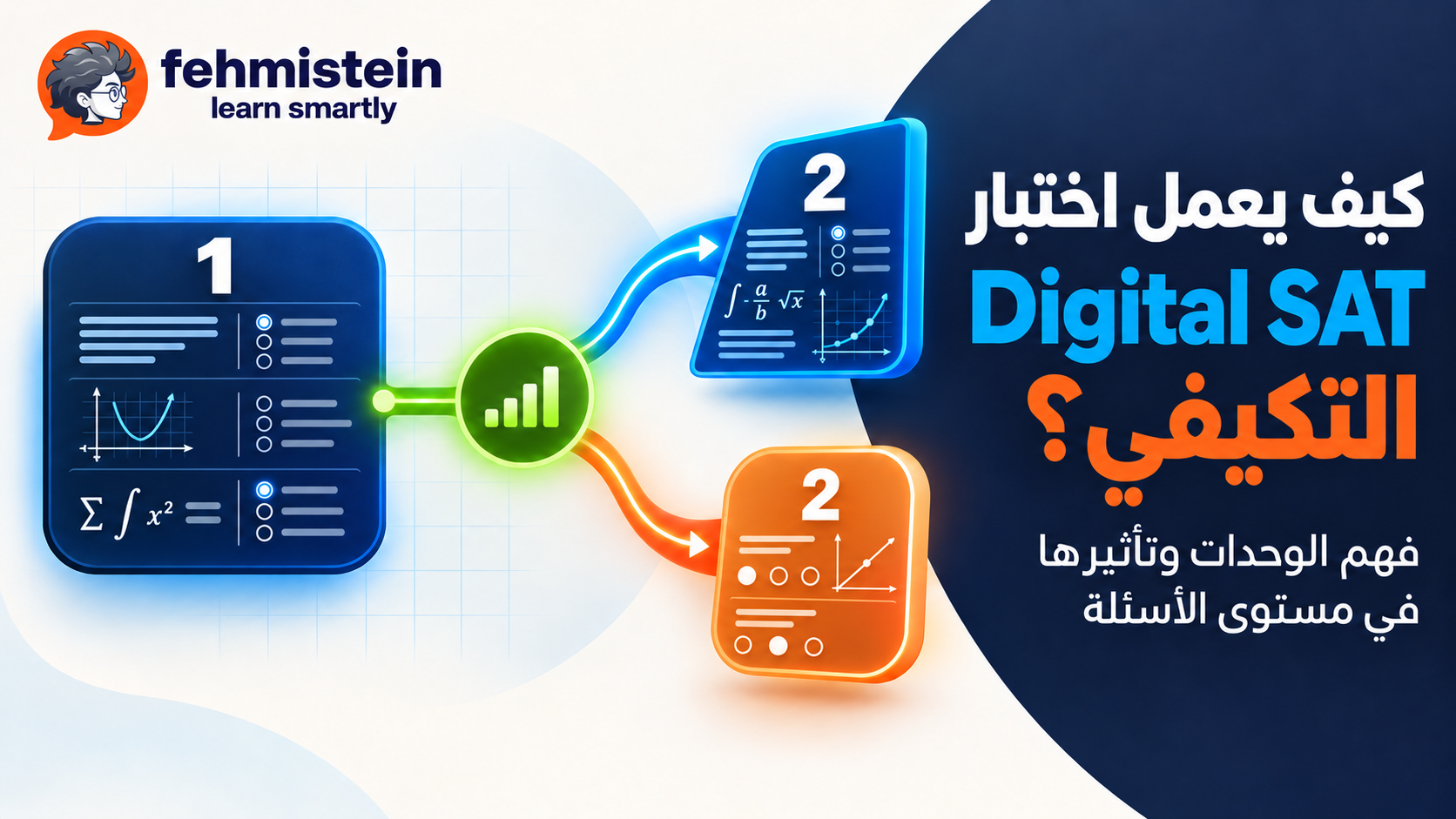
The adaptive Digital SAT test relies on a multistage adaptive system, known as Multistage Adaptive Testing. This means that the test does not change the difficulty level after every question, but instead divides each section into two modules: it starts with Module 1, and then your performance in it determines the level of the question mix that appears for you in Module 2.
Module 1 includes easy, medium, and hard questions. Based on your answers, you move to a second module that on average contains harder or easier questions. However, your score does not depend on Module 1 alone or on the path you transitioned to; it is calculated from your performance in both modules together.
This is the core idea that College Board clarifies in its official explanation of the scoring and adaptation system.
What Does It Mean That Digital SAT Is an Adaptive Test?
An adaptive test is a test that adjusts the level of questions presented to the student according to their performance during the exam.
However, the SAT does not adapt question-by-question. If you answer one question correctly, the next question will not automatically become harder, and if you get it wrong, the test will not immediately move to an easier question.
Instead, Digital SAT uses a two-stage system: you solve Module 1 completely, then the system analyzes your performance in it, directs you to one of two versions of Module 2, and the section score is calculated from your performance in both modules.
This happens independently in both the Reading and Writing section and the Math section. That is, your performance in Module 1 of Reading and Writing determines the path of Module 2 in the same section, while Math begins a new, independent adaptation process.
How Is the Digital SAT Structured?
The digital SAT consists of two main sections, and each section contains two modules equal in time:
- Reading and Writing: Two modules, total duration 64 minutes, 54 questions. Each module lasts 32 minutes and contains 27 questions.
- Math: Two modules, total duration 70 minutes, 44 questions. Each module lasts 35 minutes and contains 22 questions.
Total: 4 modules, duration 2 hours and 14 minutes, 98 questions.
There is a ten-minute break between the Reading and Writing and Math sections. Times and numbers can be reviewed via the official SAT test structure.
How Does Module 1 Work?
Module 1 is the initial measurement point in each section. It includes a wide mix of questions: easy, medium, and hard.
Its purpose is to form an initial estimate of the student’s level, so that the system can select Module 2 that provides a more accurate measurement of their abilities.
Therefore, there is no “easy” Module 1 and no “hard” Module 1 that the student chooses in advance, and not all students move to the same Module 2.
Are Module 1 Questions Identical for All Students?
College Board clarifies that all students receive the same mix of difficulty levels in Module 1. However, this does not necessarily mean that all students see the exact same questions in the same order; test forms can be equivalent without being identical.
The important point is that Module 1 gives all test-takers a fair opportunity to demonstrate their level before determining the Module 2 path.
What Happens After Completing Module 1?
After Module 1 time ends, the system uses the student’s performance to select one of two versions of Module 2:
- Higher-Difficulty Module 2: Contains a mix of questions at varying levels, but with a higher proportion of harder questions and fewer easy ones. Students who showed stronger performance in Module 1 typically move to this module.
- Lower-Difficulty Module 2: Also includes questions at different levels, but contains more easy questions and fewer hard ones. This module is designed to provide a more accurate measurement of the student’s performance within the level they demonstrated in the first stage.
Therefore, there is no Module 2 consisting entirely of extremely hard questions, nor a module consisting entirely of easy questions. Both contain a mix of levels; the difference lies in the average difficulty and distribution of questions.
Can You Know Your Path from the Difficulty of Module 2?
You cannot be sure of the path based on your feeling alone.
Module 2 may seem hard because the questions cover topics you do not master, or because you entered it under time pressure. Conversely, it may seem easy because you trained well on the types of questions that appeared in it.
Also, each module contains different levels; therefore, you may encounter relatively easy questions even in the higher module, and questions requiring thinking in the lower module.
For this reason, it is not recommended to try to infer the score during the test. The best approach is to treat each question as an independent opportunity to improve the section’s performance.
Does One Wrong Question Move You to the Lower Path?
No. The path is not determined by a single isolated question.
Transition to Module 2 depends on the overall performance pattern in Module 1, not on the first question, the last question, or a question that seems easy to you.
College Board does not publish a fixed number of errors that automatically leads to transition to a certain path, because questions differ in their characteristics and difficulty levels, and the scoring system uses a statistical model more complex than simply counting correct answers.
Therefore, there is no official rule such as: one mistake means the higher path, or three mistakes mean the lower path, or answering the last question correctly determines the path. These are circulating estimates, not rules published by College Board.
Is Module 1 More Important Than Module 2?
Module 1 is important because it affects the path you will get afterward, but this does not mean that Module 2 is less important.
The section score is calculated from performance on all scored questions in both modules. Therefore, you should not treat Module 1 as the real test and Module 2 as a secondary stage.
The correct strategy is: maintain accuracy in Module 1, do not consume excessive time on a single question, continue focusing in Module 2, and answer every possible question before time ends.
College Board’s scoring explanation confirms that the section score depends on the student’s performance in both modules together.
Does the Lower-Difficulty Path Put a Cap on the Score?
Possible score ranges differ according to the Module 2 path, because the higher module contains harder questions and allows the system to measure high levels more accurately.
However, College Board does not publish a simplified rule that determines a single fixed maximum score for the lower path that applies to all forms, such as circulating claims that the maximum score is always 590 or 600.
The official scoring diagram clarifies that the lower path covers a range that starts from low scores and extends above the section’s college readiness benchmark, while the higher path covers a range that starts below this benchmark and extends up to 800, with an overlap area between the two paths’ ranges. A student can achieve College Board’s benchmark in either path.
Therefore, moving to the lower path does not mean that all your answers were wrong or that your score will be very low. But it indicates that Module 1 performance directed the test toward a mix more suitable for the initial estimate of your level.
Does Getting the Higher Module Give You Extra Points?
You do not receive points just for transitioning to the higher module, nor are points deducted just for transitioning to the lower module.
The type of Module 2 is not a reward or a penalty. It is part of a measurement mechanism designed to present questions appropriate to the performance level you demonstrated.
If you move to the higher module and then get a large number of its questions wrong, you will not automatically receive a high score. Similarly, if you move to the lower module and answer well, you may achieve a good score within the range available for that path.
Conclusion: The path determines the question mix, but the score is affected by the quality of your answers in both modules.
How Is the Digital SAT Score Calculated?
The score is not calculated through a simple conversion of the number of correct answers to fixed points.
Digital SAT uses a statistical methodology known as Item Response Theory (IRT). The scoring model takes into account factors including:
- The number of correct and incorrect answers.
- The difficulty level of the questions you answered.
- The characteristics of each question.
- The response pattern and the likelihood that guessing is involved.
Therefore, two students may answer the same number of questions correctly but receive different scores if the characteristics of the questions they answered differ.
Each section score ranges from 200 to 800: Reading and Writing from 200 to 800, Math from 200 to 800, and the total score from 400 to 1600. College Board explains the details of this mechanism on the “How Are Scores Calculated?” page.
Do All Test Questions Count Toward the Score?
Each module contains two experimental questions known as Pretest Questions. These questions are used to collect data and evaluate their suitability for future tests, and the student’s answers to them do not affect their score.
The student cannot distinguish experimental questions from scored questions; they appear within the test in the same way. Therefore, you should answer all questions seriously and not try to guess which question is unscored.
Is There a Penalty for Wrong Answers?
There is no benefit to intentionally leaving a question blank. College Board recommends answering even when unsure, especially if you can eliminate one or two options.
If you get stuck on a question: eliminate illogical options, choose the best possible answer, flag the question, move to the next one, and return to it if time remains. Do not allow one question to consume the time allocated for several other questions.
Can You Return to Module 1?
You can navigate freely between questions within the same module, and review and change your answers before its time ends.
However, after finishing Module 1 and moving to Module 2, you cannot return to the previous module’s questions. Also, unused time cannot be transferred from one module to another. Therefore, you must complete your review before the timer for each module ends.
Are Questions Ordered from Easiest to Hardest?
The test does not run entirely in one ascending line from the easiest question to the hardest.
In Reading and Writing, questions are grouped by content domains and skills, such as Craft and Structure, Information and Ideas, Standard English Conventions, and Expression of Ideas.
Questions measuring similar skills may be ordered from easier to harder within their group, then a new domain begins. Therefore, you may encounter a hard question followed by one that seems easier. Do not use question order to estimate your path, and do not assume that the last question is always the hardest.
Why Does SAT Use This System?
The multistage test allows measurement of the student’s level with fewer questions and in less time, while maintaining measurement accuracy and reliability.
The official Digital SAT specifications document clarifies that adaptation helps to: reduce test duration, direct Module 2 toward the student’s level, maintain measurement accuracy, give the student freedom to navigate within the module, and present more secure and equivalent forms.
The duration of digital SAT is 2 hours and 14 minutes, compared to about three hours in the previous paper version.
How to Deal with Module 1?
Because Module 1 affects the path of Module 2, you need a balance between accuracy and time.
- Start with the questions you know how to solve. If the question is clear, solve it, confirm the answer, then move on. Do not return to the easy question many times out of anxiety.
- Do not let one question consume the module’s time. If the solution method is not clear, flag the question and move on. You can return to it before time ends.
- Review avoidable mistakes: negative signs, units, the final requirement of the problem, punctuation, words that change the meaning of the question, and incorrect transfer of values.
- Do not seek perfect performance. Trying to guarantee every answer’s correctness may lead to leaving questions unanswered. The goal is to achieve the best balance between accuracy and completing the module.
How to Deal with Module 2?
If you feel that the questions have become harder, do not change your strategy or assume that you have obtained a high score.
Maintain the same steps: start with what you can solve, eliminate options, use Bluebook tools, use Desmos in Math when needed, flag questions that need review, and answer all questions before time ends.
And if Module 2 seems easier, do not assume that the test is over or that your score has become low. Your answers in this module still count toward the score.
Average Time Per Question
The student has approximately 32 minutes for 27 questions in Reading and Writing, i.e., about 71 seconds per question on average, and 35 minutes for 22 questions in Math, i.e., about 95 seconds per question on average.
These averages are not a mandatory limit for each question; some questions may take seconds, while others require more time. Their benefit is to help you detect whether you are falling too far behind the required pace.
Common Mistakes in Understanding the Digital SAT System
- Believing that the test adapts after every question: adaptation happens after completing Module 1, not after every answer.
- Trying to know the path during the test: feeling the difficulty of questions is not enough to determine the type of Module 2.
- Neglecting Module 2 after feeling it is easy: the score depends on both modules, so every scored answer remains important.
- Consuming most of the time in Module 1: its importance does not mean giving each question unlimited time. Accuracy and time management are both required.
- Relying on the number of errors to calculate the score: there is no fixed table that converts each number of errors to one score in all Digital SAT forms.
- Leaving questions unanswered: College Board recommends educated guessing instead of leaving a question blank, especially after eliminating some options.
- Trying to identify experimental questions: they cannot be distinguished, and trying to discover them may distract your focus and affect scored questions.
How to Train for the Adaptive Test Nature?
Solving PDF files alone is not enough, because they do not simulate the module transition process in the same way.
College Board recommends taking official practice tests via the Bluebook app; these tests use the same multistage adaptive model.
When reviewing a practice test, do not be satisfied with the total score only. Analyze:
- Errors in Module 1.
- Questions that consumed excessive time.
- Weaker areas in Reading and Writing.
- Math concepts in which errors repeated.
- Your actual use of Bluebook tools and Desmos.
- The difference between comprehension errors and speed errors.
Then train on each skill separately before running a new simulation. You can also refer to our comprehensive guide on SAT Test: Sections, Registration, Dates, and Preparation Plan to understand the full picture before starting specialized training on adaptive modules.
Training for Digital SAT with Fehmistein
The SAT track in Fehmistein helps you build gradual training instead of jumping directly between full tests without analysis.
You can benefit from:
- Placement test.
- Question banks.
- Filtering questions by skill and type.
- Adjusting training difficulty level.
- Mock tests.
- Solution displays.
- Performance analysis.
- Identifying skills that need improvement.
- AI-supported training.
The goal is to learn how to deal with easy, medium, and hard questions, maintain accuracy under time pressure, and review the reasons for errors before moving to a new test.
You can start with a free placement test on Fehmistein. If you are also preparing for TOEFL with its adaptive system, see our article: The Role of AI-Powered Performance Analysis in Improving TOEFL Results.
Frequently Asked Questions About the Adaptive Digital SAT Test
What does it mean that Digital SAT is an adaptive test?
It means that the level of the question mix in Module 2 is determined according to the student’s performance in Module 1 of the same section.
Does the question level change after every answer?
No. SAT uses multistage adaptation; therefore, the transition happens after completing Module 1, not question-by-question.
How many modules does Digital SAT include?
It includes four modules: two in Reading and Writing and two in Math.
Is Module 1 easy?
No. Module 1 contains a mix of easy, medium, and hard questions.
Does a hard Module 2 mean I got a high score?
This cannot be determined with certainty. Even if you move to the higher module, the score depends on your answers in both modules together.
Does an easy Module 2 mean failure?
No. There is no uniform pass/fail in SAT, and a range of scores can be achieved and College Board benchmarks can be met in either path.
How many mistakes move you to the lower module?
College Board does not publish a fixed number of errors. Guidance depends on Module 1 performance and question characteristics, not on a single number applicable to every test.
Can you get 800 after the lower module?
College Board’s model shows that the higher path’s range extends to 800, while the lower path covers a different range extending above the college readiness benchmark. College Board does not publish a fixed numeric maximum score for the lower path that applies to all forms.
Does the Reading and Writing module affect the Math path?
No. Adaptation happens independently within each section. The Math section begins with a new Module 1 regardless of your path in Reading and Writing.
Can you return to the previous module?
No. You can modify your answers only within the current module. After its time ends and you move to the next module, you cannot return to it.
Do all questions count toward the score?
There are two unscored experimental questions in each module, but they cannot be distinguished from scored questions.
Is it better to leave a hard question blank?
No. College Board recommends choosing the best possible answer, especially if you can eliminate some options.
Conclusion
Digital SAT uses a multistage adaptive system, not a system that changes difficulty after every question. Each Module 1 starts with a mix of levels, then your performance in it determines Module 2 as higher- or lower-difficulty on average.
However, the path alone does not determine your score. The result depends on your answers in both modules, and on the characteristics of the questions and their difficulty level within the scoring model.
Therefore, focus on what you can control: accuracy in Module 1, time management, not stopping too long on one question, maintaining focus in Module 2, answering all questions, and analyzing errors after practice tests.
Start your Digital SAT training with a free trial on Fehmistein, and practice questions and mock tests with analysis that helps you improve weaknesses.
Prepared by: The Educational Content Team
Consultancy Review: Ms. Inaya Zureik, Founder and Director of EZ Academy and Fehmistein
Last updated: September 2026
Similar Articles