Adaptive TOEFL Test 2026: A Guide to Reading and Listening
Discover How the Adaptive TOEFL Test Works in 2026, How the First Module Determines the Difficulty Level of Reading and Listening Questions, with Score Explanation and Preparation Strategies via Fehmistein
How Does the Adaptive TOEFL Test Work? What You Need to Know About Reading and Listening in 2026
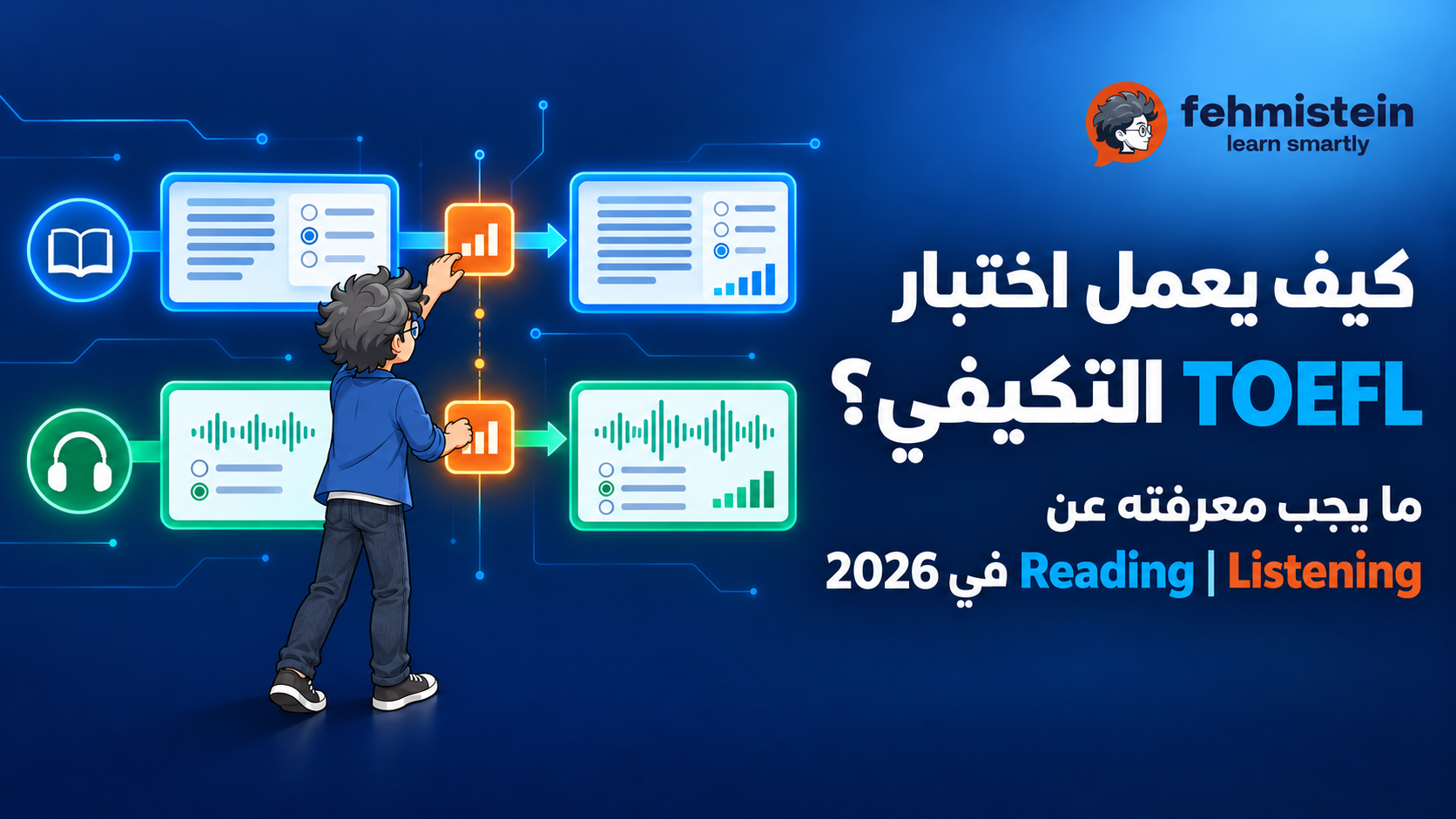
The Reading and Listening sections of the adaptive TOEFL test in 2026 have become adaptive according to a multistage system. This means that the test does not present the same set of questions at the same difficulty level for all test-takers; rather, it determines the level of the second module in each section based on your performance in the first module.
However, adaptation does not happen after every question. Each section begins with a medium-difficulty module called the Router Module, then moves to a second module at a lower or higher level. The score is calculated based on the number of correct answers and the path you received, using statistical equations that account for differences in test form difficulty.
The Short Answer: How Does Adaptive TOEFL Work in 2026?
The Reading and Listening sections operate according to the following sequence:
First Module (Medium Difficulty) → Performance Evaluation → Second Module (Lower or Higher Difficulty) → Conversion of Raw Score to Scaled Score
According to the official technical guide for the TOEFL iBT test:
- The Reading section consists of two adaptive stages.
- The Listening section also consists of two adaptive stages.
- The first stage in each section begins with medium-difficulty questions, approximately at B1 and B2 levels according to the CEFR framework.
- Performance in the first stage determines whether the second stage will be a Lower Module or an Upper Module.
- The Writing and Speaking sections do not adapt; these two sections remain linear.
Therefore, the phrase “adaptive TOEFL test” does not mean that the next question becomes harder immediately after you answer correctly. Instead, the change happens once per section, when moving from the first module to the second.
What Is a Multistage Adaptive Test (MST)?
The multistage adaptive test, or MST, is a model that divides a section into interconnected modules instead of selecting each question individually.
In TOEFL 2026, both Reading and Listening consist of:
- First Module (Router Module): A routing module of medium difficulty, designed to form an initial estimate of the student’s level.
- Second Module (Lower or Upper Module): The system selects its level based on the result of the first module.
There are two possible paths in each section:
- The lower-difficulty path, consisting of Router Module + Lower Module.
- The higher-difficulty path, consisting of Router Module + Upper Module.
The updated TOEFL iBT specifications for 2026 clarify that this design allows efficient measurement of the test-taker’s level across a wide range from A1 to C2, while maintaining diversity in reading and listening tasks.
Does the Test Adapt After Every Question?
No. This is one of the most important points to understand before taking the test.
TOEFL is not a question-level adaptive test, so the difficulty of the next question does not change directly based on your current answer. Adaptation happens at the module level: you answer all tasks in the first module, then the system analyzes your performance in it, and then you move to a second module of lower or higher difficulty.
Therefore, you should not try to infer the path from a single question, and there is no benefit in wasting time monitoring the difficulty level of each question during the test.
Why Have Reading and Listening Become Adaptive?
ETS adopted the multistage design to achieve three main objectives:
- Better matching of content level with the test-taker’s level.
- Measuring a wide range of language proficiency in a shorter time.
- Maintaining a balance between measurement accuracy and coverage of diverse language skills.
The technical guide issued by ETS indicates that the multistage test gives the test designer better control over module content, compared to tests where questions change one by one.
This means that the goal of adaptation is not to punish the student with harder questions, but to present content that allows them to demonstrate their level more accurately.
Structure of Reading in TOEFL 2026
The Reading section measures the ability to understand English texts used in daily university life and academic contexts. According to the official ETS Reading page, the section includes three types of tasks:
1. Complete the Words
A short paragraph appears containing partially missing words, and you are asked to complete the deleted letters. This task measures: vocabulary, understanding meaning from context, knowledge of word structure, and processing the text linguistically and semantically.
Recognizing the word in isolation is not enough here; solving may require attention to verb tense, plural form, appropriate suffix, and the relationship between sentences.
2. Read in Daily Life
You read short texts similar to what you might encounter in daily life or on campus, such as: a message or short email, an announcement or instructions, a schedule or list, or an informational post. Questions focus on the purpose of the text, the main idea, details, and implied meanings.
3. Read an Academic Passage
You read a short academic text similar to those used in university courses. Questions may test your ability to: identify the main idea, understand supporting details, infer meaning, track relationships between ideas, and understand academic vocabulary in context.
You do not need prior knowledge of the text topic; all information needed to answer is present in the displayed material.
How Does the Adaptive Path Affect Reading Questions?
The first module contains a mix of the three reading types. Then the distribution of tasks in the second module differs according to the path.
According to the official technical diagram, the higher-difficulty path tends to present a greater number of “Read an Academic Passage” questions, while the lower-difficulty path contains a greater focus on daily life texts. However, both paths measure real skills, and answers from both modules are included in the score calculation process.
If you feel that academic texts have become more complex in the second module, this may be an indicator that you have moved to the higher path, but it is not an official announcement of your level or a guarantee of a specific score.
Structure of Listening in TOEFL 2026
The Listening section measures understanding of spoken English in daily and academic situations. The official Listening guide outlines four types of tasks:
1. Listen and Choose a Response
You listen to a short phrase or question, then choose the most appropriate response. This task does not measure words only; it tests understanding of the speaker’s intention, the purpose of the phrase, the natural response to the situation, and common expressions in spoken communication.
2. Listen to a Conversation
You listen to a conversation often related to university life, then answer questions about the main idea, details, speaker’s intent, and implied meanings.
3. Listen to an Announcement
You listen to an announcement in an academic or campus context, such as a schedule change or instructions related to an event or student service. You may be asked about: the purpose of the announcement, key information, required action, and what is expected to happen next.
4. Listen to an Academic Talk
You listen to a short academic talk delivered by a professor or expert. The task measures your ability to understand the main idea, supporting details, organization of the talk, inferences, and some academic or idiomatic vocabulary.
Official test specifications indicate that the audio recording is played only once, so selective note-taking is an important part of preparation.
Number of Reading and Listening Questions and Time in 2026
ETS presents the following numbers and times as approximate figures:
- Reading section: about 50 items in approximately 30 minutes.
- Listening section: about 47 items in approximately 29 minutes.
The official TOEFL structure page clarifies that the number of items and time may vary with test adaptation.
The technical diagram shows that each path includes 35 scored questions in Reading and 35 scored questions in Listening, distributed as follows: 20 scored questions in the first module and 15 scored questions in the second module.
Modules may include unscored experimental questions that ETS uses for quality assurance and test development. For this reason, you should answer every question to the best of your ability and not assume that a particular question is experimental or unscored.
How Are Reading and Listening Scores Calculated in the Adaptive Test?
The test-taker receives one raw point for each correct answer in the Reading and Listening sections. However, the final score is not simply the percentage of correct answers.
ETS uses a statistical process called Equating, based on Item Response Theory (IRT). This process takes into account:
- The total number of correct answers.
- The difficulty level of the path completed by the student.
- Minor differences between different test forms.
Therefore, the reported score does not directly equal the number or percentage of correct answers. The TOEFL technical guide confirms that the score equating process aims to make the level represented by the score constant, regardless of the second module the student received or the test form they took.
Since January 21, 2026, section scores and the total score are displayed on a scale from 1 to 6 in half-point increments. During a two-year transition period, the report also includes a comparable total score on the 0–120 scale, according to ETS’s official score guidelines.
Does a Harder Question Carry More Points?
It is not accurate to say that each difficult question has a fixed number of extra points. In the raw score, you receive one point for each correct answer. After that, the statistical equating process accounts for the difficulty level of the path and the test form when converting the raw score to the reported score.
ETS has not published a simple table such as “easy question = 1 point, hard question = 2 points,” so it is not advisable to rely on unofficial conversion tables circulating on the internet.
Does Moving to a Lower Module Mean the Result Will Be Low?
Not necessarily that the final result will be “bad,” but it means that your performance in the first module directed you to the lower-difficulty module.
ETS does not publish in current documents a simple, specific ceiling for each path that can be used to pre-calculate the score. The result depends on:
- Performance in the first module.
- Performance in the second module.
- Difficulty of the path.
- The statistical equating process.
Therefore, even if you feel that the second module is easier, continue answering accurately. Giving up after trying to guess the path may lower your score more than the path itself.
Does the Difficulty of the Second Module Reveal Your Score?
A higher-difficulty module may indicate strong performance in the Router Module, but personal impression is not a reliable way to know the path.
A text may seem difficult because of its topic, the vocabulary used, or fatigue and stress, not necessarily because it belongs to the higher path. Also, reaching the Upper Module does not guarantee a specific score; your answers in the second module still matter.
The best strategy is to treat each module as a new opportunity to collect correct answers.
Best Strategy for the Adaptive Reading Section
- Give the first module high priority. The first module affects the selection of the second module’s level, and its answers are included in the score. Therefore, avoid rushing at the beginning with the excuse of saving time for the end.
- Distinguish between task requirements. In “Complete the Words,” monitor word structure, grammar, and context. In daily texts, identify the message’s purpose and required action. In academic texts, focus on the main idea and relationships between details.
- Do not turn reading into translation. Trying to translate every word into Arabic consumes time. Instead, look for: the central idea, transition words, pronouns and their references, cause-and-effect relationships, comparison and contrast, and the function of each paragraph.
- Train at varying levels. Training only on easy texts may give you high accuracy that does not continue when facing an Upper Module. Use graded materials, then solve modules that combine daily and academic texts within a fixed time.
Best Strategy for the Adaptive Listening Section
- Listen for meaning, not individual words. The answer may relate to the speaker’s intent or attitude, not a literally stated sentence. Pay attention to tone, hesitation, correction, agreement, or disagreement.
- Take brief notes. ETS allows note-taking during the test. But trying to write everything you hear may distract you. Use concise notes focusing on: the topic or problem, each speaker’s opinion, important details or examples, cause and effect, and the decision or next step.
- Train with one-play recordings. Since recordings are played only once, make your core practice without replaying the audio. You can replay later during error review, but not during the first attempt.
- Familiarize yourself with more than one accent. The section may include accents from North America, Britain, Australia, and New Zealand. You do not need to imitate these accents, but you must be able to understand them at natural speed.
Common Mistakes in Adaptive TOEFL
- Trying to guess the path instead of focusing on the current question.
- Rushing in the Router Module.
- Believing that one wrong question determines the second module.
- Psychological collapse upon noticing increased difficulty.
- Giving up when believing the second module is easier.
- Relying on the percentage of correct answers to predict the score.
- Training on old questions without mastering the new 2026 tasks.
- Writing full sentences during Listening and missing the rest of the recording.
- Training without timing or error analysis.
ETS recommends combining English development with training on test format and timing, instead of relying only on general English study, as clarified in its guide on common TOEFL preparation mistakes.
How to Train on Fehmistein for the Adaptive TOEFL Test?
To make training close to the test’s logic, start with a diagnostic test that determines accuracy levels in each task type, then distribute your time based on actual errors.
A daily training session can be organized as follows:
- Short practice on “Complete the Words” or “Listen and Choose a Response.”
- A timed set of daily life texts or conversations.
- An academic text or Academic Talk at a higher level.
- Review the reason for each wrong answer, not just knowing the correct choice.
- Finally, record results by skill: main idea, details, inference, vocabulary, speaker’s purpose, or time management.
Simulation with graded difficulty levels helps you learn an essential skill: maintaining accuracy when the material becomes more complex.
You can start with a simulated diagnostic test on the Fehmistein platform to identify actual weaknesses in Reading and Listening. You can also read our article: The Role of AI-Powered Performance Analysis in Improving TOEFL Results.
Start your training with a free trial on the Fehmistein platform.
Frequently Asked Questions About the Adaptive TOEFL Test in 2026
Is the entire TOEFL test adaptive?
No. Multistage adaptation is applied in the Reading and Listening sections. Writing and Speaking are linear sections.
How many stages are in each adaptive section?
Both Reading and Listening consist of two stages: Router Module, then Lower Module or Upper Module.
Does each question affect the difficulty of the next question?
No. Adaptation does not happen question-by-question, but when moving from the first module to the second.
Do Reading and Listening adapt together?
Each section has its own routing module and path. Your performance in Reading determines the second Reading module, and your performance in Listening determines the second Listening module.
Is the first module counted in the score?
Yes. The first module is not a separate preliminary test; its answers are included in the score and determine the path of the second module.
Can I know the path during the test?
The labels “Lower” or “Upper” are not usually shown to the student. Difficulty level may give an approximate impression, but it does not reveal the score or path with certainty.
Are all Reading and Listening questions scored?
Modules may include unscored experimental questions. Therefore, all items should be treated seriously.
Can I replay the recording in Listening?
ETS specifications clarify that recordings are played only once, so you must train on focused listening and brief note-taking.
Do I need prior knowledge of the text or lecture topic?
No. Questions are designed so that the necessary information to answer is present in the text or recording, and no prior specialized knowledge is assumed.
Does the number of correct answers alone determine the score?
No. Correct answers contribute to the raw score, then a statistical equating process is used that accounts for path difficulty and differences between test forms.
Conclusion
The adaptive TOEFL test in 2026 is not a test that changes the difficulty of every question instantly. Both Reading and Listening consist of a first medium-difficulty module, followed by a second module of lower or higher level depending on performance.
Success in this design does not depend on trying to trick the algorithm or guess the path, but on three clear skills:
- Accuracy in the first module.
- Stability when difficulty changes.
- Timed training on all types of new tasks.
Every correct answer matters, but the final score is not a simple percentage; it is the result of a standardization process that considers performance and path difficulty. Therefore, make your goal to understand the language and answer consistently, and leave score calculation to the ETS system.
To prepare for the TOEFL test with its new adaptive system, explore the smart training tracks on the Fehmistein platform. For a free educational consultation about choosing the right test, contact the EZ Academy team via WhatsApp:
Phone: +90 552 574 12 76
Direct link: https://wa.me/905525741276
Prepared by: The Educational Content Team
Consultancy Review: Ms. Inaya Zureik, Founder and Director of EZ Academy and Fehmistein
Last updated: September 2026
Similar Articles