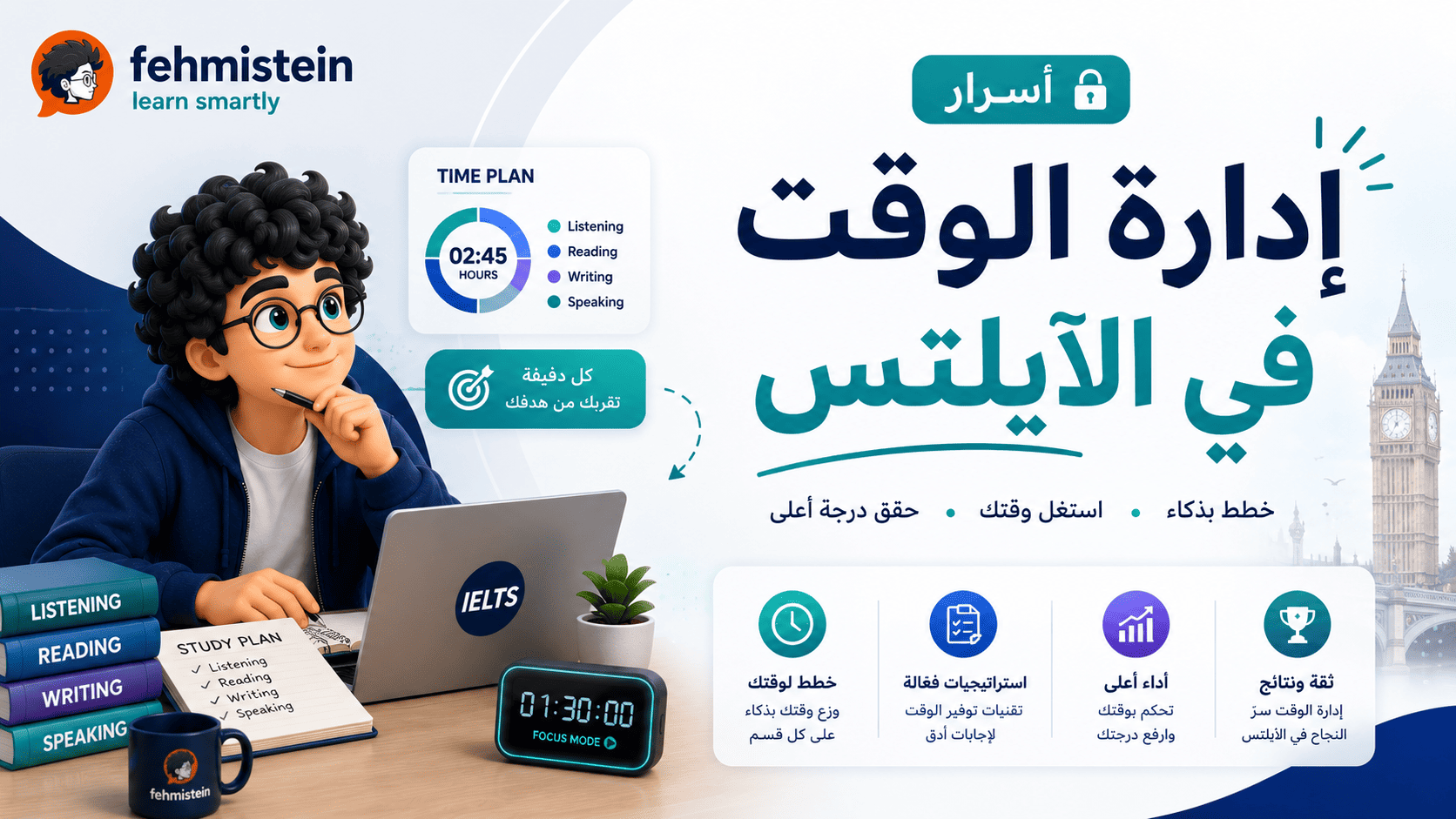
Secrets of Time Management in the IELTS Exam: Your Practical Section-by-Section Guide to Achieving Band 7+
Time Is Your Biggest Competitor in IELTS
Discover the secrets of time management across all four IELTS sections—Listening, Reading, Writing, and Speaking—with practical strategies from Fehmistein to achieve Band 7 or higher.
Introduction: Why Do Excellent Students Lose Marks in IELTS?
Time is one of the biggest challenges in the IELTS test, even for students with excellent language skills. This is reflected in a question repeated by thousands of students after every attempt:
“My English is good, but I did not have enough time!”
In a test that lasts approximately three hours, the clock is your biggest competitor—not the examiner. Success depends not only on your vocabulary and grammar, but also on the time-management strategy you use to control every minute and every second.
In this article from Fehmistein, we reveal practical strategies for managing time across all four sections, highlight common mistakes, and explain how to turn time pressure from an enemy into a useful tool.
Listening: Predict Before You Listen
The Listening section consists of 40 questions completed in approximately 30 minutes, which means you have less than one minute per question. The key is not simply writing quickly, but using the few seconds between recordings proactively.
Use the time before each recording
You have a few seconds before each recording begins to read the upcoming questions. Use this time to identify the type of information required:
- A person’s name.
- A telephone number.
- A date.
- A place.
This prediction helps you listen with sharp, selective attention rather than general and unfocused concentration. Listening recordings are generally played only once, which makes preparation and concentration especially important.ielts.idp
Follow the “do not get stuck” rule
If you miss an answer, move on immediately without hesitation. The recording will not stop for you, and confusion over one question may cause you to miss the answers to several following questions.
Do not correct answers during the recording
Many students waste time reviewing previous answers while the recording is still playing. Save this review for the final 10 minutes, and do not allow it to distract you from the current recording.
Reading: Take Control Through Skimming
Reading is the section in which many students lose the most time. The main reason is that they read every sentence in detail as if they were reading a book for pleasure.
Use Skimming and Scanning
Learn to skim the passage quickly to understand its general idea. Then scan it selectively to search for the keywords and details needed to answer the questions.
Apply the 20-minute strategy
Divide the 60-minute section equally among the three passages:
- 20 minutes for Passage 1.
- 20 minutes for Passage 2.
- 20 minutes for Passage 3.
Do not give the first passage more time than it deserves. Your goal is to collect as many points as possible across all three passages, not to master one passage at the expense of the others.
The Reading section gives you 60 minutes for 40 questions, so managing the time assigned to each passage is essential.britishcouncil.org
Be careful with “exact-word” questions
Some students search for the exact sentence from the question in the passage. However, IELTS frequently uses paraphrasing. Train yourself to recognize meaning rather than search only for identical words.
Writing: Plan to Write Faster
The Writing section lasts 60 minutes and includes two tasks with different weightings. One of the most common mistakes is giving both tasks the same amount of time.
Recommended time distribution
Task 1 — 20 minutes
This task involves describing data, a graph, chart, diagram, or process. Spend no more than 20 minutes on it because it carries less weight in the final Writing score.
Task 2 — 40 minutes
Task 2 is the argumentative essay and is more important because it carries greater weight.
Divide the 40 minutes into three stages:
- 5 minutes for planning and organizing the structure.
- 30 minutes for writing.
- 5 minutes for language review.
Reviewing is not optional. It is your best opportunity to correct small errors that may cost you valuable marks.
Speaking: Stay Calm Under Pressure
Although Speaking is a face-to-face interview with an examiner, the time is still carefully controlled. A smart candidate knows how to use this limited time effectively.
Give clear and direct answers in Part 1
Do not make your answers unnecessarily long. The examiner is working within a limited schedule, and short, clear answers are better than unfocused explanations.
Use natural “thinking phrases” in Part 3
If you need a moment to think before answering a complex question, use natural expressions such as:
“That’s an interesting question…”
or:
“Let me think about that for a moment…”
These expressions give you a little thinking time without making your hesitation or silence seem awkward.
Use your preparation time in Part 2
You have one full minute to prepare before speaking for two minutes. Use this minute to write brief keywords—not complete sentences that may distract you while speaking.
For more speaking strategies, read The OREO Strategy for Organizing Your IELTS Speaking Part 3 Answers.
Common Time-Management Mistakes
Starting with the most difficult Reading passage
Start with the easiest passage to secure accessible points, then move to the more difficult passages.
Writing without planning
Starting to write immediately without organizing your ideas can produce a disorganized essay that requires rewriting, causing you to waste time twice.
Ignoring the Listening review time
The final 10 minutes of the Listening section are designated for reviewing and transferring answers. Many students waste this valuable time.
Giving in to Speaking anxiety
Anxiety can make time feel as though it is passing twice as quickly. Practicing deep breathing before entering the test room can reduce stress and help you remain mentally calm.
How Fehmistein Helps You Master IELTS Time Management
Time management is not learned by reading about it alone. It is developed through guided practice under realistic pressure.
At Fehmistein, we help you develop this skill through:
- Realistic mock tests: Timed tests through the Tests Page that familiarize you with the actual pace of the exam rather than the relaxed pace of ordinary practice.
- Detailed weakness analysis: We help you identify which section consumes more time than it should and provide specific techniques to reduce that time professionally.
- Problem-solving strategy lessons: We do not only teach you English; we teach you how to solve questions as quickly and accurately as possible.
- A structured learning environment: Focused content is available through our flexible packages, helping you improve consistently in every study session.
If you are at the beginning of your IELTS journey and still looking for a clear starting point, we recommend reading IELTS Roadmap 2026: How to Start from Zero before exploring advanced time-management strategies.
Frequently Asked Questions
Can I finish the Reading section within the time limit?
Yes, but it requires regular practice with Skimming and Scanning. Most students who complain about a lack of time have not practiced these techniques sufficiently.
What should I do if the time for Writing Task 1 ends before I finish?
Stop immediately and move to Task 2. Task 2 carries greater weight in the final score, so an incomplete Task 1 is much better than failing to complete Task 2 at all.
Is practicing time management at home enough?
Home practice is useful, but it does not accurately reproduce the pressure of the real test. Practicing in a realistic environment with a strict timer is what truly helps you adapt to pressure and improve your performance on test day.
Start Working Toward the Score You Deserve
Do not allow time to become an obstacle between you and your academic ambitions. With proper preparation and guided practice through Fehmistein, time management can change from your greatest weakness into your strongest advantage in the test room.
Similar Articles