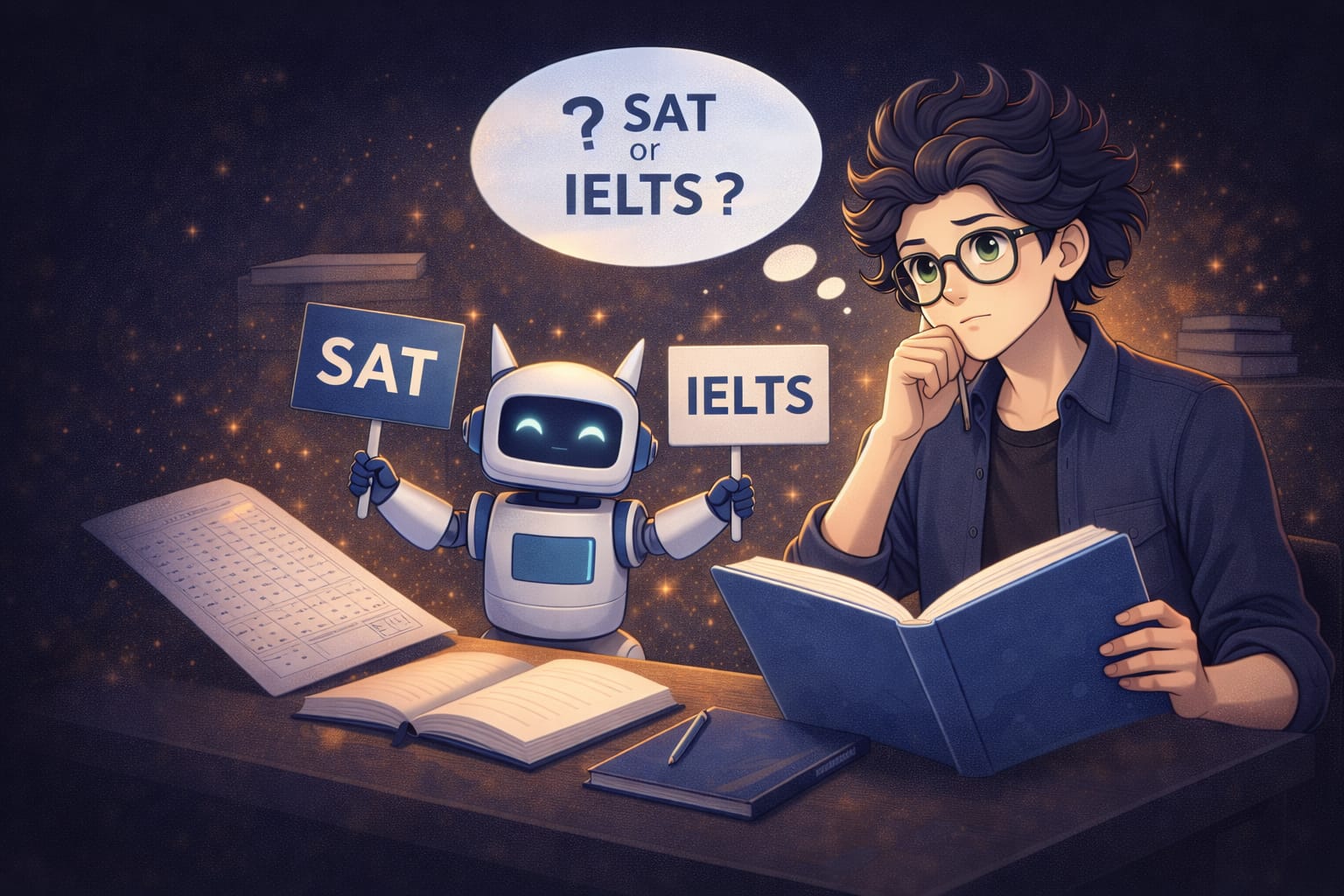
Do you need the SAT or IELTS to obtain a university scholarship? A complete and detailed answer for Arab students.
The most frequently asked question among Arab students who want to study abroad is: Do I need the SAT or IELTS to get an international university scholarship? The short answer is: no, not always required, but the matter is much deeper than that.
The truth is that the answer depends on four main factors that cannot be ignored: the type of scholarship and level of study, the target country, the specific university and its requirements, and the strength of your academic and personal profile. In this comprehensive guide, you'll learn about the role of each test—SAT, IELTS, and TOEFL—in international university scholarships, how to choose the right test for your goal, and the most important scholarships that do not require these tests for Arab students.
1) What Is the SAT and When Is It Required for University Scholarships?
The SAT, or Scholastic Assessment Test, is an academic aptitude test designed to measure your readiness for university study. It consists of two main sections:
- Evidence-Based Reading and Writing.
- Mathematics with and without a calculator.
The total score ranges from 400 to 1600, and an excellent score for competitive scholarships is 1300 or above.
The SAT is mainly required in:
- Undergraduate scholarships at major American universities such as Harvard, Yale, MIT, and Stanford.
- Some Canadian universities like the University of Toronto and the University of British Columbia.
- U.S. government scholarships like Fulbright for undergraduate study.
In contrast, the SAT is not required or is optional in:
- Most European scholarships like DAAD, Chevening, and Erasmus.
- Government scholarships in Turkey, Malaysia, and China.
- Master's and doctoral programs that sometimes require GRE instead.
Important note: After the COVID-19 pandemic, the SAT became optional at more than 1,800 American universities, but applying without it weakens your chances in highly competitive full-funding scholarships.
2) What Is the IELTS and Why Do Most University Scholarships Require It?
IELTS, or the International English Language Testing System, is the most famous international test of English proficiency. It consists of four integrated skills:
- Listening: 40 minutes, 40 questions.
- Reading: 60 minutes, 40 questions.
- Writing: 60 minutes, including an essay and describing a graph or table.
- Speaking: An interview with an examiner lasting 11-14 minutes.
Each skill is scored from 0 to 9, and the overall band is what most international scholarships require.
IELTS is required in cases such as:
- 90% of European scholarships in the UK, Germany, the Netherlands, and Sweden, usually requiring 6.5 or above.
- UK scholarships like Chevening and Commonwealth, usually requiring 6.5-7.0.
- Scholarships in Australia and New Zealand, usually requiring 6.5 or above.
- Most Canadian universities, usually requiring 6.5-7.0.
IELTS is not required in:
- Scholarships taught in the national language, such as German in Germany or French in France.
- Scholarships in Turkey, Malaysia, and China that allow acceptable alternatives.
- Universities that accept a MOI certificate proving previous education was in English.
For how to improve your English level to reach the required score, read Learn English Intelligently: A Practical Guide to Success in IELTS, TOEFL, and SAT.
3) TOEFL vs IELTS: Which Is Better for Your Scholarship?
The core difference between the two tests goes beyond the name and reaches the evaluation method and target environment.
TOEFL iBT is conducted fully on a computer in one session lasting about three hours. It is more common in American and Canadian universities, and the required score for scholarships ranges from 80-100 or above.
IELTS Academic allows choosing between paper-based and computer-based versions, and the speaking section is conducted separately with a human examiner. It is more common in Europe, Australia, and New Zealand, and the required score for scholarships ranges from 6.5-7.5.
To choose the best for you, follow these criteria:
- If you prefer computer interaction, choose TOEFL.
- If you are strong in spoken conversation, choose IELTS.
- If your goal is American universities, TOEFL is often better.
- If your goal is European universities, IELTS is often better.
The golden advice: always check the specific university or scholarship requirements first before deciding, as some accept both but most prefer one specific test. For deeper understanding of these tests, read What Do International Tests Really Measure? A Comprehensive Guide to IELTS, TOEFL, and SAT 2026.
4) Fully Funded University Scholarships Without SAT or IELTS for Arab Students
Yes, there are prestigious scholarships that do not require SAT or IELTS, ideal for Arab students without these certificates. The most prominent include:
- Türkiye Scholarships: Cover bachelor's, master's, and PhD with full funding including tuition, housing, living expenses, flights, and insurance. IELTS can be replaced by a Turkish language certificate or free Turkish course included with the scholarship.
- DAAD Germany Scholarships: Cover master's and PhD with full funding including tuition plus €934/month. IELTS can be replaced by MOI or TestDaF for German study.
- Chinese Government Scholarship (CSC): Covers all levels with full funding. IELTS can be replaced by free Chinese course or MOI.
- Hamad Bin Khalifa University Scholarship (Qatar): Covers master's and PhD. IELTS can be replaced by language interview or prep course.
- Swedish Institute Scholarship (Sweden): Covers master's. IELTS can be replaced by MOI or proof of prior English-medium study.
The common requirement is a good academic GPA, strong motivation letter, and relevant volunteer activities. For how to build a complete profile for these scholarships, read How to Build a Balanced University Scholarship Profile to Increase Your Acceptance Chances?.
5) How Do SAT and IELTS Scores Affect Your Actual Chances?
International tests are not just formalities; they are powerful distinguishing tools that directly impact your position among applicants.
SAT's role in scholarships appears in three axes:
- Proves your academic abilities beyond varying school grading systems.
- Distinguishes you among thousands with similar GPAs.
- Increases financial aid chances by 30-50% in American universities.
IELTS or TOEFL's role:
- Proves real academic readiness for English lectures and research.
- Reduces risks for the sponsoring university.
- Essential condition in 80% of fully funded international scholarships.
High-scoring students are prioritized in the first review circle. For why strong profiles get rejected, read Why Do Qualified Students Get Rejected from International University Scholarships?.
6) When to Start Preparing for SAT and IELTS?
The ideal timeline starts 6-12 months before deadlines, divided into three stages:
Stage 1 (Months 1-2: Assessment & Planning):
- Take a free diagnostic test.
- Set a clear target like IELTS 7.0 or SAT 1400.
- Create a realistic 1-2 hour daily plan.
Stage 2 (Months 3-5: Intensive Training):
- Daily practice on all four skills.
- Weekly full mock tests.
- Deep error analysis.
Stage 3 (Month 6: Official Test):
- Book 6 weeks in advance.
- Retake if needed (90% of students do).
Key Warning: Less than 3 months usually leads to weak scores and higher rejection risk. For when to start, read When Should You Start Preparing for University Scholarships and Why Is Timing Crucial for Acceptance?.
7) How to Choose the Right Test Step by Step?
Choosing is not random; follow these four steps:
- Define Geographic Goal: SAT/TOEFL for US/Canada; IELTS for Europe; alternatives for Turkey/China/Germany.
- Assess Current Level: Free samples on official sites (IELTS.org, College Board).
- Check Requirements: Review Language Requirements; email admissions.
- Personal Style: IELTS for writing/analysis; TOEFL for computer adaptation.
8) Common Mistakes Arab Students Make
- Late prep (<3 months) → weak scores, incomplete file.
- Surface memorization → ignores analytical skills.
- Ignoring IELTS Speaking → equal weight to all skills.
- No full mocks → unprepared for time pressure.
- Old scores → no progress shown.
For broader errors, read Common Mistakes That Destroy Your Scholarship Chances.
9) Proven Strategy for Success
Successful Arab students follow this 5-point pattern:
- Accurate level check in week 1.
- Commit to one test.
- 1-2 hour daily plan for 6 months.
- Deep error review.
- Confident retake if needed.
Result: Excellent score → strong file → acceptance.
For handling tough questions, read How to Deal with Difficult Questions in International Tests Without Losing Time or Focus.
Frequently Asked Questions
Should I start with SAT or IELTS first?
IELTS/TOEFL first (essential for most), then SAT for US/Canada.
Is IELTS 6.0 enough?
Yes for Turkey/Malaysia; Europe needs 6.5+. Strong profile compensates.
Prep time for SAT/IELTS?
3-6 months organized, based on level/target.
Scholarships without language tests?
Yes, Turkey/Germany/China via MOI/courses.
SAT for master's?
Rarely; GRE sometimes.
IELTS score and acceptance?
Direct/strong link; higher score = first review/lower risk.
Conclusion: SAT, IELTS, and the World of International University Scholarships
SAT and IELTS are not absolute requirements for all international university scholarships, but they open much wider doors to US, Canadian, European, and Australian universities. Meanwhile, fully funded scholarships without them in Turkey, Germany, and China are real, strong options for Arab students.
The success secret is early organized prep starting 6-12 months before deadlines, choosing the right test matching your geographic goal and style.
Start today: assess your level and build your plan via EZ Academy Platform to step toward your scholarship.
Similar Articles