School and the Fahmy Stein Platform: How Are Life Skills Built Without You Noticing?
When someone mentions the word "school," the mind immediately jumps to images of books, exams, and grades. However, this picture reflects only a small part of the reality. At its core, school is a comprehensive formative environment whose impact extends far deeper than academic knowledge; it is the place where the student's mind, personality, and way of interacting with the world are shaped.
What no single textbook teaches, daily situations inside the classroom do. What cannot be measured by a number on a report card is gauged by the student's ability to work with others, handle pressure, and make decisions in critical moments. These are the real life skills that school quietly instills in its students without fanfare.
Why school is more than just academic achievement
School education in its broad sense does not stop at transferring information from the book to the student's mind. School is a living social environment where the student learns how to interact with those who differ from them, manage conflicts, and collaborate toward a common goal. These social and emotional competencies are not acquired solely from the teacher's explanation but accumulate gradually through hundreds of small daily situations the student encounters.
In the student's school life, every group activity, research project, and class discussion is a disguised training opportunity for life skills. Awareness of this reality transforms school from merely a station for obtaining a certificate into a true platform for building the human being.
Key life skills built in school
1. Teamwork and collaboration with others
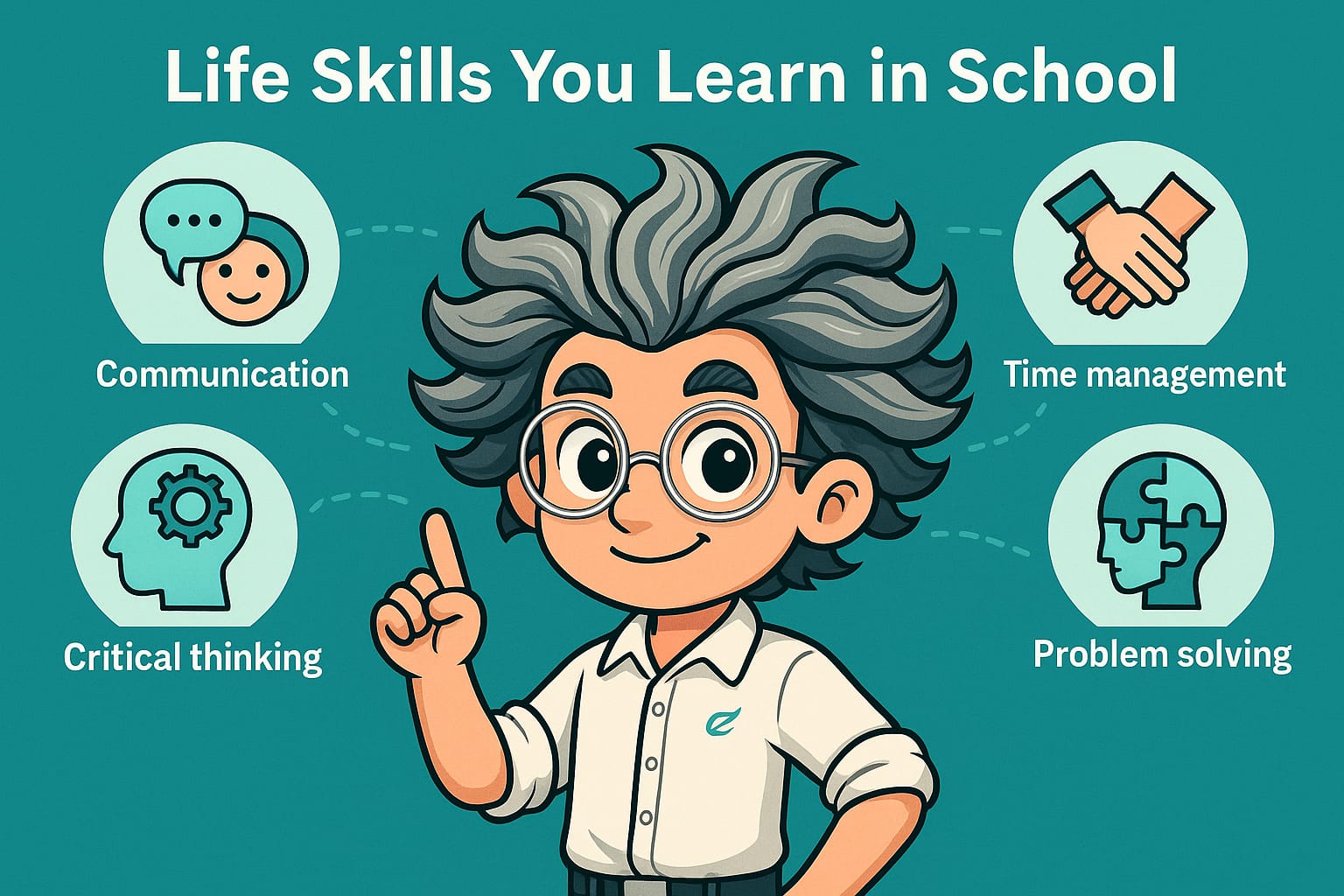
No one is born with an innate ability for effective teamwork; it is a skill acquired and refined through practice. Classroom collaborative projects and extracurricular activities provide fertile ground where the student learns to assign roles, respect differing opinions, and contribute meaningfully to a shared outcome. Those who do not master collaboration in school often struggle in later work environments.
2. Critical thinking and problem-solving
Every math problem solved, literary text discussed, or scientific experiment conducted is disguised training in critical thinking. The student accustomed to viewing situations from multiple angles before judging develops an analytical mind that aids them throughout life in making better decisions and solving problems effectively.
3. Communication and self-expression skills
Teaching the student to express their ideas clearly and precisely in front of peers or the teacher is practical training in one of the most important life skills. Effective communication is not just speaking; it includes true listening, reading body language, and choosing the right words in the right context. This skill often makes the difference between people with equal knowledge.
4. Time management and planning
School life by nature places the student before a daily challenge: how to balance homework, activities, exams, and rest time? This daily challenge is essentially continuous practical training in time management and effective planning. The student who masters this skill in school gains a real competitive edge in their university and professional career later.
5. Leadership and personal responsibility
Representing the class, leading a sports team, or overseeing a school project—all these seem small but plant the seeds of true leadership in the student. Taking responsibility before peers and being accountable to the teacher fosters awareness of belonging and commitment, which are the deepest components of a leader's character.
6. Emotional intelligence and empathy with others
School life is full of emotions: joy in success, disappointment in failure, competition, friendship, and conflict. Dealing with this wide emotional spectrum daily develops the student's emotional intelligence—their ability to understand and control their feelings while empathizing with others. According to the latest psychological research, this emotional intelligence is one of the strongest predictors of future personal and professional success.
Fahmi Shtayn platform: your smart partner in building life skills
Recognizing that school teaches deeper than books is an important step, but the bigger question is: how do we consciously and systematically enhance these skills? This is where the Fahmi Shtayn platform shines as a smart academic and developmental partner for the student in their educational journey. It does not limit itself to supporting academic achievement but accompanies the student in discovering themselves and developing personal competencies in a smart, customized way.
What makes the Fahmi Shtayn platform different?
The platform relies on advanced AI techniques to analyze each student's learning pattern individually, then delivers tailored content that strengthens their strengths and addresses weaknesses in an adaptive, seamless style. This means every student gets a learning experience designed specifically for them, not a one-size-fits-all group experience.
Moreover, it integrates academic skills with personal skills in a comprehensive educational system through interactive programs that help the student understand their learning style, develop critical thinking and problem-solving, and make decisions in real-world practical contexts.
It also provides targeted training activities to aid in time management and organizing short- and long-term goals, preparing them not just for upcoming exams but for life as a whole.
With the Fahmi Shtayn platform, learning does not stop at textbook boundaries. The student learns how to think, plan, communicate, and lead—all with smart accompaniment that adapts to their level and celebrates their progress step by step.
Frequently asked questions about life skills and school education
Can life skills be learned outside school?
Yes, life skills can be acquired from diverse experiences outside school, such as family, social activities, and community involvement. However, school remains the most organized and consistent environment for acquiring these skills systematically and gradually, thanks to the daily, diverse interaction opportunities with peers and teachers.
How can parents support developing life skills in their children?
The parental role starts with awareness: ask your children about their daily experiences, not just their grades. Encourage participation in school activities and group initiatives. Let them make small decisions in daily life—this is the true cradle for growing life skills.
What is the difference between academic skills and life skills?
Academic skills relate to school content like math, sciences, and languages, measured by tests and grades. Life skills are competencies that enable dealing with real-world challenges, such as communication, time management, collaboration, and flexibility. Both are essential, and the best education develops them in balance and integration.
Conclusion: School builds the human, Fahmi Shtayn completes the building
School is not a station to pass exams and move on. It is a real workshop where the human of the future is shaped. Every situation the student encounters within its walls—whether a lesson, activity, or conflict with a peer—is a brick in building their personality and life skills.
Since this journey deserves a smart companion that understands each student's needs, the Fahmi Shtayn platform stands by the student to give this journey greater depth and clarity. Because the true goal of education is not measured by a grade on paper, but by a human capable of thinking, communicating, leading, and giving.
Similar Articles